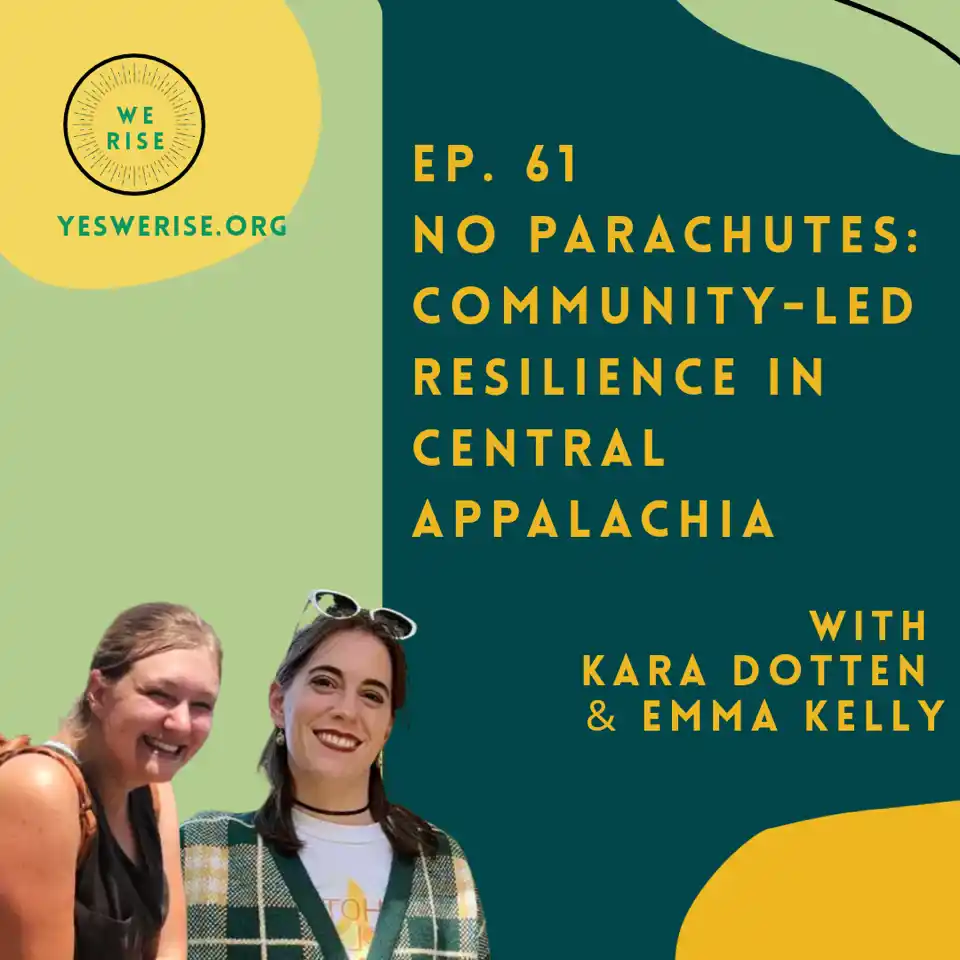
Episode 61 of the Yes! We Rise podcast
What does it look like when a nonprofit stops parachuting in and starts following a community’s lead? In this episode, Christine sits down with longtime colleagues Emma Kelly and Kara Dotten of the New Economy team at Appalachian Voices. Emma lives in Lee County and Kara in Wise County, both rooted in the coalfields of far Southwest Virginia. Through the Community Strong initiative, they’ve walked alongside five small towns—Dante, Clinchco, Pennington Gap, Pound, and Dungannon—listening, returning, and listening again, until residents’ own priorities became a reality. Ideas turn into funded projects including: a flood-prone, abandoned grocery building demolished to make way for a flood-mitigating park, a historic train depot on its way to becoming a solar-powered resilience hub, and an aquatic center celebrating the Clinch River carrying a beloved mayor’s legacy forward.
Emma and Kara share hard-won lessons on building trust: respecting the hyper-local wisdom of each place even when you’re from the region, showing up messy and honest instead of polished, compensating residents as the experts they are, and committing to communities “in perpetuity, as long as they want us.” They also open up about leaving and coming home, the humor and pride of people living Appalachia rather than touring it, and how they stay grounded (and avoid burnout) in work that always feels urgent. It’s a warm, wise, and practical conversation for anyone who wants to help their community rise from the ground up. Welcome to the Yes! We Rise Podcast!
Key Takeaways for Change-Makers:
- Go to the experts—the community. Residents at every level are the true experts in their place. Without them, you’re working with an incomplete picture.
- Don’t just ask—return. Community Strong held three rounds of meetings in each town so residents could refine, prioritize, and help decide what to seek funding for, instead of a one-and-done listening session.
- Respect the hyper-local. Even people from the region don’t automatically understand the culture or flooding issues of the next town over. Bring a beginner’s mind.
- Be human, not polished. Being honest, messy, goofy, and vulnerable builds more trust than showing up as the experts.
- Make participation possible. Food, stipends, welcoming kids (with giant sticky notes at kid level to draw on), and welcoming residents’ knowledge as professional expertise all matter.
- Go deep, not wide. Focusing on five communities for the long haul beats doing a half job in many places.
- Tangible results build momentum. When people know construction funding is in place, they know they’re not speaking into the void.
- Take care of yourself. Take time off—this work can burn you out, and you need rest to return at your best.
find this episode on youtube
Chapters
[00:00] Welcome and introductions: Emma Kelly and Kara Dotten of Appalachian Voices
[00:44] Appalachian Voices and the New Economy Program—clean water, black lung benefits, and community visions across the seven coalfield counties
[02:56] Why community vision comes first: no more organizations “parachuting in”
[04:49] Building trust: respecting hyper-local cultures and showing up honest, messy, and human
[08:03] Emma’s path: from Bell County, Kentucky, and a family of park rangers to cultural anthropology
[09:24] Kara’s path: trying to leave, falling in love with home, and coming back to Wise
[12:02] Painting a picture of Southwest Virginia: Clinch River biodiversity, High Knob, inherent trust, and memories embedded in the land
[14:39] “Appalachia is trendy”: the humor and pride of living it versus touring it
[15:34] Christine reflects on land, storytelling, ways of knowing, and the fear of change
[18:32] Community Strong: listening sessions, stipends and food, and building ownership
[20:23] Common themes: flood resilience, green space, economic development, and the need for a place to be connected
[21:45] Why these five communities—and why going deep beats going wide
[24:02] Entrenched challenges: infrastructure, flooding, and feeling ignored by higher levels of government
[26:26] Pennington Gap with Emma: from an abandoned, flood-prone grocery building to a flood-mitigating park with an accessible playground and fishing pier
[30:06] Getting to know Pennington Gap (about 1,500 people) and Dungannon (about 289 people)
[31:14] Dungannon with Kara, the “Heart of the Clinch”: Mayor Horne’s legacy, a new community association, and a solar-powered depot resilience hub
[34:10] “In perpetuity”: partnering for as long as communities want them
[35:14] What is a resilience hub—and why it matters in rural communities
[36:21] What holds communities back, and the leverage points that move them forward
[39:48] Engagement best practices: food, stipends, kids welcome, and compensating local experts
[42:07] Remembering Mayor Horne and Letting Love Lead Yes! We Rise podcast episode
[44:30] Staying grounded: running, theater, mushroom foraging, yoga, pets, family—and community partners who inspire
[46:43] Lessons learned: be humble, cede power, take time off, and know the legislative process is there for you
[48:46] How to connect with Appalachian Voices and closing reflections
Notable Quotes
From Emma
“We’re all people trying to figure out how to work through this together.”
“They know it’s not just planning, they know they’re not speaking into the void.”
From Kara
“Just because I’m from Wise doesn’t mean that I get to speak on Clinchco.”
“No one’s actually willing to sit down with the community and say like, hey, sorry, this didn’t work and here’s why. They just leave.”
From Emma and Kara
“Community members at all levels are the true experts in their community. And if we want to make lasting change, if we want to make effective change, you have to go to the experts.”
“It’s not just showing up and asking, it’s also returning.”
“It’s not just asking communities what they want, but asking the communities how to make it happen.”
“Choosing five [communities] and choosing to focus in tight on those is better than doing a half job in a bunch of places where we’re not able to have those deep relationships.”
About Our Guests
Emma Kelly
Emma Kelly is the New Economy Program Manager at Appalachian Voices. Originally from Bell County, Kentucky, Emma holds both a B.A. and M.A. in cultural anthropology, focusing on human rights and environmental justice in Appalachia. She is passionate about bringing in as many voices as possible to help build a sustainable and just future for Appalachian communities from the ground up. Her work with Appalachian Voices is centered around equitable collaboration with local communities, building resilience from the ground up, and bringing in funding to make communities’ visions come true. Emma currently lives in Lee County and loves hiking, gaming, and spending time with her husband, daughter, and furbabies.
Kara Dotten
Kara Dotten is the New Economy Program Coordinator at Appalachian Voices and a graduate of the UVA Wise Visual & Performing Arts Program. She is a Virginia Master Naturalist and offers monthly hikes and nature-based learning opportunities for her community. She is also an active board member for the Pro-Art Association and a volunteer for local stewardship and outdoor recreation projects. In her spare time, Kara enjoys running, hiking, backpacking, and nature photography. She lives in Norton, Virginia.
About the Podcast
The Yes! We Rise podcast is produced by Dialogue + Design Associates, with music by Drishti Beats.
Follow the We Rise podcast on Facebook and Instagram.
Please rate, review, and subscribe to the podcast so we can continue spreading our message far and wide. Find our email list at the website: www.yeswerise.org. Thanks for listening.
Now more than ever, our world needs brave, visionary leaders to create positive change on a global scale. We need individuals and community organizers to rise up and build a future that allows our granddaughters and grandsons to thrive.
But where do these leaders come from? What inspires and motivates their impact? And how can the rest of us begin? How do everyday people take practical steps to “create the change they want to see in the world”?
At Yes! We Rise, we have solutions.
After 20 years helping individuals and leaders build a brighter future together, we know for a fact that real change happens based on the local ideas of local leaders.
You already have the power to make a meaningful impact. We’ll get you inspired and show you how.
At Yes! We Rise, we’re on a mission to help community leaders and members learn to forge a new path toward creating resilience and true transformation. One person at a time, one community at a time, one region at a time, the quilt of transformation can grow piece by piece until resilience becomes the norm instead of the exception.
To create change, people like you and me need to feel like we belong and that we are part of a growing movement. You need to know that your voice matters. That you have the agency and ability to transform your life and community. That you are the key to a resilient future.
If you’ve ever wanted to make a bigger difference inside your own community, or you’ve struggled to imagine what it would look like for you to create a more sustainable life and world, the Yes! We Rise podcast is for you.
From the Navajo Nation to the mountains of Appalachia, incredible work is already being done to create a more sustainable future. Community members are no longer waiting for someone else to come and save them. They realize they are the ones they have been waiting for.
On the Yes! We Rise podcast, we share the stories, strategies and tools of these ordinary people making an extraordinary impact.
When you hear and see what others have done to create real, true and lasting change (especially people in similar situations and places to you), you will begin to imagine what’s truly possible for you.
When you listen and learn from their stories and strategies, you’ll feel the spark they do and find new ways to create the change you want to see.
We’re here to help you get fired up to kick some ass, take inspired action, and dream even bigger—for yourself, your community
Links/Resources Mentioned:
Appalachian Voices — visit the website, sign up for the (geo-targeted) mailing list, and follow on Facebook, Instagram, and Bluesky
Community Strong — Appalachian Voices’ community-led initiative in Dante, Clinchco, Pennington Gap, Pound, and Dungannon
Mineland Releaf Project — shared by Emma and Kara
Solar Workgroup of Southwest Virginia — shared by Emma and Kara
Yes! We Rise Episode 9: Letting Love Lead with Mayor Horne of Dungannon, Virginia
Other organizations and programs mentioned: EPA Environmental Justice Collaborative Problem-Solving grant, The Nature Conservancy’s Cumberland Forest Fund, Virginia Department of Environmental Quality, Virginia Department of Conservation and Recreation, Green and Healthy Homes Initiative, Appalachian Regional Commission READY Local Governments, Environmental Defense Fund, Monuments Across Appalachian Places, Virginia Master Naturalists, and the Pro-Art Association.
Learn more about Yes We Rise: yeswerise.org
Join Christine’s community work at Dialogue + Design: dialogueanddesign.com
Follow on social @yeswerise
The Yes! We Rise podcast is produced by Dialogue + Design Associates, Worthfull Media, music by Drishti Beats.
Follow Yes! We Rise on Facebook and Instagram.
Please rate, review, and subscribe to the podcast so we can continue spreading our message far and wide. Find our email list at the website: yeswerise.org. Thanks for listening.
Transcript
No Parachutes: Community-Led Resilience in Central Appalachia
Episode 61 of the Yes! We Rise podcast
Transcript
Christine Gyovai (00:00)
Right, so excited to have Emma and Kara from Appalachian Voices on the We Rise podcast today. Longtime colleagues. just really delighted to see both of you. Would you like to introduce yourself so folks know who I have the delight of speaking with today?
Emma and Kara (00:14)
Yeah, hey folks, I’m Emma Kelly. I’m the New Economy Program Manager at Appalachian Voices on the New Economy team out of far southwest Virginia. and I live down in Lee County. Hey everybody, I’m Kara. I work in the same office and on the same team that Emma does as the New Economy Program Coordinator, and I currently live in Norton, Virginia.
Christine Gyovai (00:35)
Great. So tell us a little bit about what it’s like where you live. Why Appalachian Voices? What is the New Economy Program?
Emma and Kara (00:44)
so Appalachian Voices itself is a regional nonprofit that works on environmental issues. So we work across several states. but the Central Appalachian office, which is in Norton, Virginia, houses the New Economy program. And we work on several things from making sure that folks have clean drinking water, access to black lung benefits.
working to make sure that communities’ visions for their future is is being worked on through grants and providing some technical assistance for those folks. so it’s it’s a lot of different types of work, but it really kind of all comes back to putting the community’s needs and and wants first. Yeah. And generally
Christine Gyovai (01:23)
Love that.
Emma and Kara (01:24)
in our area, we say we work across the seven Coalfield counties. So it’s a lot of it’s very rural, a lot of small towns that
we’re built on coal mining and continue to be impacted by coal mining with a decent mix of agriculture thrown in as well. So it’s it’s real pretty mountain country in our communities. Yeah.
Christine Gyovai (01:41)
Mm-hmm. Yeah,
absolutely. listeners might be familiar with some earlier episodes we’ve had with Appalachian Voices team members. we have partnered with Appalachian Voices and worked on projects with Appalachian Voices for many years and have a deep respect for the work that Appalachian Voices does. And it’s a a long-term nonprofit organization that’s really shifted the approach.
To the work over the years, I’d say. And I’m really looking forward to hearing more about how that work is grounded today. I loved what you said about, the community’s vision for the future, putting community vision and needs first, and Appalachian voices, and both of you are really leading a lot of that work. But that hasn’t always been the case with the way that nonprofits have approached Appalachia or, you know, across the the globe. sometimes
nonprofits and other well-meaning entities have said, here’s what we want to do, here’s our the path forward that we see, let us bring our way of doing things to you. But that’s been different than the way that Appalachian Voices has been taking an approach. Can you tell us a little bit more about the why behind the work first? Why do you take this approach? And what does that look like more in practice, putting a community’s vision first?
Emma and Kara (02:56)
Well,
I think part of it is especially with with the organization as a whole, but then especially within our team, almost everybody that we work with who who we employ in Southwest Virginia is from Southwest Virginia, or from the Central
Christine Gyovai (03:10)
Mm, mm.
Emma and Kara (03:12)
Appalachian region. And so we all, you know, keenly feel, we all have experience working with groups or organizations who have kind of parachuted in. We’ve
We’ve seen what that’s like, we felt what that’s like, it hasn’t been great.
Christine Gyovai (03:24)
Mm, yeah, yeah.
Emma and Kara (03:27)
so we we have that that personal experience that, you know, we don’t want to replicate that. And I think it also comes from a shared understanding that community members at all levels are the true experts in their community. And if we want to make
Christine Gyovai (03:41)
Mm.
Emma and Kara (03:43)
lasting change, if we want to make effective change, you have to, you have to go to the experts.
Which are the community members. Otherwise, you’re just working with an incomplete picture. Yeah. I think I would I would just add that the way it shows up in practice for a lot of this work and especially around the Community Strong Initiative is in these communities where we’ve forged these relationships and tried to maintain these kind of deep working relationships. It’s it’s not just showing up and asking, it’s also returning. So a big part of the Community Strong Initiative, for example, was asking.
Folks to tell us about what they wanted to see, about solutions that they saw to issues in their communities. But then it was also going back and having them refine those, prioritize those, help us figure out what to actually seek funding for, to give us additional context around them. So it’s it’s not just asking communities what they want, but asking the communities how to make it happen and how to do that. And that
has forged a much deeper relationship, I think, in those communities than just having a one and done check-a-box listening session. Yeah.
Christine Gyovai (04:49)
Yeah,
love that. So key. So we’re gonna dive into the community strong process and communities in a little bit. But you’ve just touched on a few key things, particularly relationships and trust. That’s certainly something we’ve we’ve seen in your work and in our work with communities, is those are the two things that move the needle in long-term work or relationships and trust. And without those two things.
the needle really doesn’t move, but it it takes time to do that. what have been some ways that have allowed community members to trust you? And what have been some key elements of building relationships in communities?
Emma and Kara (05:26)
I
think for me, one of the biggest surprises in starting this job is that I’m from Wise. I’ve always lived in Wise. So,
Christine Gyovai (05:34)
Mm-hmm.
Emma and Kara (05:34)
like born here, Appalachian, have always been to Pound and Pennington Gap and the surrounding areas that we do our work in. And yet I had to like find and respect that there are these very specific cultures that come out of these very specific places. So just because I’m from Wise.
doesn’t mean
Christine Gyovai (05:53)
Right.
Emma and Kara (05:54)
that I get to speak on Clinchco or
Christine Gyovai (05:57)
It’s not.
Emma and Kara (05:57)
that I understand where all the flooding issues happen in Dante. Like there’s still an expertise that I’m lacking that I think I maybe assumed that I had before hopping in because I’m from
Christine Gyovai (06:07)
Interesting.
Emma and Kara (06:07)
the the Coalfield region. And so for me I think a big part of the trust and what’s allowed me to to form that trust is like respecting that separation. There’s a culture that unites us, but there’s also these like really kind of key differences.
Yeah, I think y yeah, being of the communities in a way that kind of transcends the professional barrier because it’s you know, we do live here. So if we go to the grocery store, we go to the park, or we go to a local meeting or something in a personal capacity, we’re still bumping into people.
Christine Gyovai (06:40)
Mm-hmm.
Emma and Kara (06:41)
so it it builds those personal ties. And I think even when we’re showing up to the communities in a professional capacity, it’s so important to be as
honest as possible. and that involves being messy and sometimes being goofy and just kind of being vulnerable
Christine Gyovai (06:58)
Yes, love that.
Emma and Kara (06:59)
with people instead of coming in like, hey, you guys, we’re experts and we’re very polished. We have
Christine Gyovai (07:04)
Right.
Emma and Kara (07:05)
all this knowledge that we want to impart upon you. That’s
Christine Gyovai (07:07)
Great.
Emma and Kara (07:08)
not effective. That’s really not accurate to the situation. It’s just we’re all people trying to figure out how to work through this together.
Christine Gyovai (07:16)
Love that. So some of the key themes I’m hearing are not assuming that just because you’re from the region, you’re the expert. Still
Emma and Kara (07:24)
Right.
Christine Gyovai (07:24)
listening to place, still listening to people, still understanding that very specific place, hyper local, home place based wisdom that people have. So bringing that beginner’s mind, if you will.
welcoming the messy, welcoming the goofy, not being the expert who knows it all, but being able to to hear what’s important wrong, to be able to build relationships to build with and together. I would love to hear a little bit more about each of your backgrounds, Tell us a little bit more about why you do this work. Why is it important to you and and what are you hoping to see in the region?
Emma and Kara (08:03)
So let me go first. Yeah, so I am originally from Bell County, Kentucky.
so
just it’s across the mountain from where I live now. also a coal mining community. And I was raised by two national park rangers. So that that is
Christine Gyovai (08:20)
Hmm.
Emma and Kara (08:22)
where I got my interest and love and conservation, but
That is it’s a very curated version of conservation, right? If you’re if you’re in the National Park Service, if you’re coming from
Christine Gyovai (08:28)
Mm. Right, right. Yeah.
Emma and Kara (08:31)
that perspective. And so, you know, I went off to college. My background is cultural anthropology. So I spent my bachelor’s and my masters looking at Appalachia, looking at agency and activism and the way that’s a lot of people approach the area. And I was just like, it it didn’t quite hit right.
Christine Gyovai (08:53)
Mm.
Emma and Kara (08:54)
And I was
able to look at my own upbringing and be like, I got this appreciation for where we’re at, but again, from a very specific perspective. And once I was connected with folks at Appalachian Voices, actually for my master’s thesis, that was the first time that I started having conversations with people from the region working in the region that actually really jived with my own perspective and my my own feelings about our
Christine Gyovai (09:17)
Mm, mm-hmm.
Emma and Kara (09:18)
communities and how our communities are kind of transitioning. so that’s how I came to
Christine Gyovai (09:21)
Mm-hmm. Yeah, fascinating.
Yeah.
Emma and Kara (09:24)
Yeah.
Yeah. I have sort of a a weird twisty turny path here, I guess. But the
Christine Gyovai (09:30)
Mm-hmm.
Emma and Kara (09:31)
short of it is that I I was born in Wise and
Christine Gyovai (09:33)
Mm-hmm.
Emma and Kara (09:35)
from a young age was engaged in theater and went to school for theater and puppetry and always actually
Christine Gyovai (09:41)
Mm-hmm.
Emma and Kara (09:42)
assumed that I was going to move. That was sort of like a a given. It was also very much the culture in my high school that you know, success basically just meant moving.
Christine Gyovai (09:52)
Mm.
Emma and Kara (09:53)
And I very much agreed with that, aligned with that. I tried to move multiple times. I tried to go away
Christine Gyovai (09:58)
Mm-hmm.
Emma and Kara (09:58)
to a different school at first. At another point, I I took a job that was, you know, far away after college to get some travel experience. And and every time I tried to leave, I was like, no, I love this this very specific culture too much to leave.
Christine Gyovai (10:09)
Mm, yeah. Yeah.
Emma and Kara (10:13)
and all of these things that I thought meant you were not successful, like being a homebody.
wanting to really have close familial ties and see the same people in the grocery store all the time, for example, were really true about me. And so I sort of finally just had to like give it up and come back.
Christine Gyovai (10:26)
Mm-hmm. Mm-hmm. I love that.
Emma and Kara (10:30)
and so somewhere around the time of the the pandemic, I realized that I was super interested in the outdoors and in citizen science and joined the Virginia Master Naturalists and had always kind of admired
Appalachian voices work from the outside based on, you know, the principle of giving the reins to the people in the community. And so when a job became available, I applied and it’s the it’s the best job I’ve ever had.
Christine Gyovai (10:58)
Yeah, Love hearing that. And so many interesting threads. people talk a lot about people leaving and why, but there’s a real sense of recognition and a appreciation for what is and and knowing how that foundation really helps create a stronger path forward way of who you are. a lot of people in that I talk to talk about moving and searching and moving and searching, and they continue.
through a moving and searching process. But when you accept and recognize and value that groundedness, it gives you a different way to kind of move through the world.
Emma and Kara (11:33)
Yeah, ironically, we are tabling tomorrow at the Fall Fling and the Fall Fling, both times I came back was the thing that I missed. It was like this small town sort of autumn festival where you can
Christine Gyovai (11:41)
Mm. Mm-hmm. Love that. Yeah.
Emma and Kara (11:45)
see all the people who you went to high school with and your old clogging
Christine Gyovai (11:47)
Yeah.
Emma and Kara (11:47)
teacher and the person who works, you know, yeah, you get your donut call rolls and your phone. Yeah. Yeah. And I was like,
Christine Gyovai (11:53)
Yeah.
Emma and Kara (11:53)
I just want that to be every day where I can like leave my house and and know the the bread man and know my neighbor and you know.
Christine Gyovai (11:55)
Yeah. Yeah. Mm-hmm. Love that.
Emma and Kara (12:00)
yeah. I’m I’m glad to be back.
Christine Gyovai (12:02)
So for people who might not be familiar with how beautiful Southwest Virginia is and the broader region of central Appalachia and what it means to know the bread man, for example, can you paint a little bit more of what the picture of the community is like, about what the culture is like, the things that help make it strong and maybe the things that hold it back.
Emma and Kara (12:24)
I mean I think the first thing that comes to my mind is just why the recreation is so special here. Like why people are so drawn to the outdoors and a big part of it is just the the biodiversity. We have more
species of freshwater mussels in the Clinch River than anywhere else in the world. We’ve got the highest point in the Cumberlands at High Knob. We’ve got a new destination center. So there’s lots of reasons that people want to to come here to recreate. But in terms of the actual culture, that is so tricky to put into words. Yeah, I think it was always so interesting to me, especially when I was at college.
Which I just went to UT at Knoxville. It was it was not far away. It was not a giant
Christine Gyovai (13:03)
Mm-hmm, yeah, yeah.
Emma and Kara (13:05)
city. but even then people would find out I was from southeastern Kentucky and they’d be like, my God, aren’t you aren’t you scared to go home? Aren’t you do you go outside at night? Which was the most bizarre question
Christine Gyovai (13:15)
Hmm. Hmm. that’s interesting.
Emma and Kara (13:19)
to me because I feel like broadly there’s a pretty strong sense of inherent trust here because it
is so
Christine Gyovai (13:27)
Mm-hmm.
Emma and Kara (13:28)
rural because people have
Kind of made due for so long. Like you do have comfort because people generally trust
Christine Gyovai (13:33)
Mm-hmm.
Emma and Kara (13:36)
each other and generally assume that folks are working, you know, from a good place in their hearts. and then I think another big part of that is that where we do have a lot of generational residents, that adds a really special dynamic to the relationship with the land.
So it’s not just,
Christine Gyovai (13:56)
Mm-hmm.
Emma and Kara (13:57)
you know, it’s not just going out and hiking. It’s not just going out and fishing. A lot of times it’s going on old family land. Or I remember early on in my relationship with my husband, his family was in Harlan County, Everts, coal miners, way, way, way back.
Christine Gyovai (14:10)
Mm-hmm.
Emma and Kara (14:11)
And he was able to take me out driving and point to 30 to 35 different like old family plots of land and cemeteries and just
Christine Gyovai (14:19)
Mm-hmm, mm-hmm.
Emma and Kara (14:21)
all these memories that were embedded.
in the landscape. So where somebody might come to the area and be like, this is beautiful, beautiful mountains, beautiful forests. it’s an entirely separate thing to, you know, go with somebody who’s from the area and have all that emotion tied to it. Yeah.
Christine Gyovai (14:36)
Mm-hmm, mm-hmm.
Emma and Kara (14:39)
Yeah. It’s funny that you sort of brought up like the people coming in versus people being here because one sort of piece of the landscape that I see changing is
I do feel like Appalachia is trendy right now. Like element where people are
Christine Gyovai (14:54)
Mm, mm, mm, yeah.
Emma and Kara (14:57)
sort of really interested in the spooky, the the rules. We have the cryptids, we have possums. Yeah, and people are super interested in that. But one thing I found that has
Christine Gyovai (15:03)
Yeah.
Emma and Kara (15:06)
developed out of that, I don’t know if you’ve seen this too, is that there’s like a piece of there’s a type of humor that has
Christine Gyovai (15:13)
Mm.
Emma and Kara (15:13)
come out of people who live here and who have been entrenched in this place for a long time that
is often around the tough things about Appalachia, like joking about how many dollar generals we have.
Christine Gyovai (15:21)
Mm, mm-hmm, mm-hmm.
Emma and Kara (15:25)
And sort of like the pride being in in in the parts that actually can be really difficult. And that being sort of a difference between people who are like living it versus people who are sort of touring it. Yeah.
Christine Gyovai (15:34)
Mm-hmm. Mm-hmm.
Yeah, absolutely. And I think that gets to the part I was asking about too, about what can hold people back from being willing to engage and change,
I grew up in the eastern panhandle of West Virginia, but my dad’s family is a coal mining family from southern West Virginia. And my husband’s from Charleston. My mom’s side of the family’s from New England. And it’s been so fascinating to have that context and background, particularly connection to land.
And love of place. You know, I grew up with my father being very connected to land and being outside and and having ways of knowing that weren’t easy to verbalize necessarily, you know, where to find Molly Moochers or Morels or how to know when it was the right time to plant the garden. Just a different way of knowing and a different way of connecting with land and a different way of being in terms of telling stories. know, storytelling is very much a part of our family’s culture.
And my mom side of the family, and neither one is better or worse, but my mom’s side is much more intellectual, much more head-based, and less storytelling. when I go to different parts of central Appalachia, there is almost always this puzzle fitting that happens. So where are is your family from? Where’d you grow up? You know, what’d you do? And there’s this kind of context and placemaking that happens first. And a lot of that has to do with relationship to place and long-term relationship to place.
And it’s in the bones of people, literally. One side of my family is the bone family. So we talk about that. But in some of the places that I’ve worked, there’s been a real hesitation to welcome people to come to that place. And I think maybe in some places, certainly not all, that’s because of a fear of not being able to continue to have a place.
A fear of not, you know, family history not being recognized, if community culture not being recognized, a fear of loss, a fear of change, that the very thing that people love might become eroded or might go away if things change too much. And so without I I think recognizing that fear and holding space both for history and storytelling and also to hear what’s important for people, it’s really hard to create a sense of welcoming
At the same time, especially for communities whose economies have been based on coal or timber, just as the as coal and timber supplies have dwindled and that that economy is not able to be based on those natural resources anymore, what comes next? It’s hard for people to think about what comes next until they sometimes feel grounded in place, recognized for how they are intertwined with land.
So talk a little bit about your work with communities. What role is Appalachian Voices playing? What are you hoping to do in communities? Moreover, and you’ve already said this, what are communities hoping to do and how are you helping to make that happen?
Emma and Kara (18:32)
Yeah, so when we started Community Strong, we chose five communities across five counties. And we started off with very general listening sessions, and that included like stipends and food and like our our best way to compensate people for the time and energy that they were putting into it. But
Christine Gyovai (18:46)
Mm-hmm. Mm-hmm.
Emma and Kara (18:48)
that was kind of our our level setting. And we had been working with these communities before, but it was more kind of like piecemeal grant work and
Christine Gyovai (18:57)
Mm-hmm.
Emma and Kara (18:58)
waiting on them to approach us.
And
this was our way of saying, okay, let’s sit down with everybody. Let’s get the same group of people in the room, hopefully three times over. We had three sets of meetings in each community and hear everything they want and then figure out where Appalachian Voices can actually tie in and get some of this work done. And I think that was a really effective way to start out. because it did it built in that that sense of openness.
And that sense of ownership from the people who were coming to the meetings because they they knew that what they were telling us was what we were going to work with. We weren’t gonna, you know, pull something out of left field, we weren’t gonna like
Christine Gyovai (19:39)
Right.
Emma and Kara (19:40)
mold and adapt it. it was very, very straightforward, very at face value. And of course, you you hit a point where you can only ask people what they want so much. And then they’re like, We keep telling you this. Please, please stop wasting our time. We have told you, we we have,
Christine Gyovai (19:49)
Mm. Huh, yeah, yeah, mm-hmm, hmm, huh.
Emma and Kara (19:56)
you know.
Binders full of listening session notes and data. So we got to a point where we felt very comfortable knowing what the priorities were. And then it was a matter of using our resources to find funding, find resources, bring it back to the community members, and then start from come kind of a new level of we want to work on this with you. Let’s actually get some things in motion.
Christine Gyovai (20:21)
Mm-hmm. That’s great.
Emma and Kara (20:23)
In terms of what their priorities were, we we saw different things across all five communities, but we did see a lot of themes re-emerge across those communities. So some of those, the big ones were flooding resilience, access to green space, economic development, making sure that there was access to grocery stores and other like critical infrastructure.
what else came out of those? Those were the main ones. I mean, I think the absolute biggest category was just having a place to be connected. And it was interesting
Christine Gyovai (20:58)
Mm.
Emma and Kara (20:59)
because it was something we heard in every single every single community, every single meeting,
Christine Gyovai (21:03)
Mm.
Emma and Kara (21:05)
from kind of every single demographic. Yeah. You know, you had a lot of kind of the older generations who were there prior to the coal boom, experienced the coal boom.
and have kind of a nostalgia and they they want to pay tribute, they want to honor, you know, the legacy that made this place what it was and that helped make the rest of the country what it was. And then you had newer families, people with small kids, people who had maybe come into the region, who were also looking for some kind of way that they could fit into this bigger picture.
so the biggest thing was people feeling disconnected and wanting to prioritize any project.
That would fix that. Yeah.
Christine Gyovai (21:45)
Mm-hmm.
Yeah, that’s great. So how did you choose these five communities? What is the community strong process? why did this process get started and how did you build that initial trust in working with them?
Emma and Kara (22:00)
So the five communities, it’s Dante which is in Russell County, Clinchcoe, which is in Dickinson, Pennington Gap in Lee County, Pound and Wise County, and then Dungannon and in Scott County. And a few years ago, our team applied for an environmental justice collaborative problem-solving grant. it was from the Environmental Protection Agency. And we picked those communities because we already had some kind of connection there. You know, we we had
Christine Gyovai (22:26)
Mm-hmm.
Emma and Kara (22:27)
a starting place. And
we saw a lot of potential.
Christine Gyovai (22:31)
Mm-hmm.
Emma and Kara (22:32)
these these were not the most resourced communities
Christine Gyovai (22:35)
Mm-hmm.
Emma and Kara (22:36)
in the area, but they were the communities that have like wonderfully passionate residents, really, really good community leaders, and a a lot of big visions for what they want.
Christine Gyovai (22:47)
Mm-hmm.
Emma and Kara (22:49)
Yeah, one of our community partners who works in in one of these areas
always says when people ask like how did you start working with Appalachian voices her answer
Christine Gyovai (22:58)
Mm.
Emma and Kara (22:59)
is like we needed help and they offered you know it was sort of an arbitrary
Christine Gyovai (23:02)
Mm-hmm. Love that.
Emma and Kara (23:04)
thing and I think for us these five communities are not the only ones that need help but choosing five
Christine Gyovai (23:10)
Mm-hmm.
Emma and Kara (23:10)
and choosing to focus in tight on those is better than sort of doing a half job in a bunch
Christine Gyovai (23:18)
Mm-hmm.
Emma and Kara (23:19)
of places where we’re not able to have those deep relationships.
Yeah, because we had started from a place and I mentioned this earlier of kind of piecemealing where we were doing similar work, but these issues are so entrenched and they’re so they’re so layered on one another that
Christine Gyovai (23:33)
Mm-hmm.
Emma and Kara (23:36)
you could do, you know, one good in one community, one project in another, and it’s kind of like putting a piece of tape over a bullet wound. It’s just not you need
Christine Gyovai (23:44)
Mm-hmm.
Emma and Kara (23:45)
to build up that trust, you need to build up that knowledge, and you need to be willing to like really dig in.
Christine Gyovai (23:51)
Mm-hmm.
Emma and Kara (23:51)
And work with
these communities for ten years, fifteen years, kind of in in perpetuity, because these problems
Christine Gyovai (23:55)
Mm-hmm.
Emma and Kara (23:58)
were so long in the making.
Christine Gyovai (24:02)
And so what are some of those problems that you’re talking about? what has made things become entrenched? And what are some of the things that people have talked about Where they want to go from here? Where are some of the visions that communities have?
Emma and Kara (24:15)
Infrastructure is such a big one. just with you know, dwindling population, aging population, dwindling tax base,
Christine Gyovai (24:24)
Mm-hmm.
Emma and Kara (24:25)
infrastructure is a consistent issue. And that’s something where most of that is not in Appalachian Voices purview. Like we are happy to help, you know, lend support
Christine Gyovai (24:32)
Mm-hmm. Right. Right.
Emma and Kara (24:34)
on an AML grant or a Department of Transportation project or something, but that’s that’s really not our expertise.
But figuring out things like utilities, shoring up the grid, focusing on specific community buildings, that is where we can help. so we put
Christine Gyovai (24:51)
Mm-hmm.
Emma and Kara (24:52)
a lot of energy in there. I would say just the increase in flooding, which
Christine Gyovai (24:56)
Mm-hmm.
Emma and Kara (24:57)
is linked to to so many things, to extractive industries, to people just having a lack of resources, to to people not having the ability to move and their land being more wealth, some
Christine Gyovai (25:06)
Mm-hmm. Mm-hmm.
Emma and Kara (25:08)
of these smaller places and so
Working on some nature-based flooding solutions, other kinds of flood mitigation. You know, Emma’s worked on a few projects in Pennington Gap that would, you know, create a wetland and also create a nature-based flood mitigating park that is actually
Christine Gyovai (25:26)
Mm-hmm.
Emma and Kara (25:27)
in a flood zone, for example, solutions like that. And then I think kind of uniting the infrastructure and community piece with the flooding and working on resilience hubs. So
Christine Gyovai (25:37)
Mm-hmm.
Emma and Kara (25:37)
places that people can go and be in community when there’s, you know, power outages and and people need access to things like phone chargers and a fridge to store their their insulin, for example. Yeah. And I think the other big thing for a lot of folks who showed up to our community meetings was
I guess a feeling, not a lack of empowerment, but simply the feeling of being ignored by some of the the higher levels
Christine Gyovai (26:01)
Mm.
Emma and Kara (26:02)
of government, some of the the larger regional organizations doing work in the area. So I think the other big problem that Community Strong has been like trying to address is building up that grassroots power, making sure that community members know that not only will we advocate for what they want, but we will work with them to build up an advocacy movement.
In the way that they want.
Christine Gyovai (26:26)
Mm-hmm. Love that. So you’ve created a space for people to come together, to be connected, to tell you what they want to see, Can you walk us through a little bit more, maybe in two communities, what the process has actually looked like on the ground from the initial idea
for getting people together to idea for a vision project and what it looks like to get grants. So if someone in another community is like, okay, this is interesting, but where do I get started? We don’t have an Appalachian voices. What do we do? Can tell us a little bit more about, perhaps for a resilience hub and for flooding, how you’re addressing flooding, or another example, what it actually looks like in terms of some of the steps and then what are the key factors that are important for people who want to engage in this work,
if they’re in a role to help out or if they’re in a role, you know, who w they want to ask for help.
Emma and Kara (27:18)
Yeah. Do you want to do Dungannon and Pennington Gap? Sure. Yeah. So if we start with Pennington Gap, because we’ve had a a couple of projects result from that process. So you know, back in I think it was early 2024. Yes, early 2024, we had our first community meeting. That was,
Christine Gyovai (27:37)
Mm-hmm.
Emma and Kara (27:37)
like I said, kind of the the level setting. People came in, they said, We have an abandoned building problem. We
Would like to see more recreation. And then I think they just said economic diversification as their three priorities. So
Christine Gyovai (27:50)
Mm-hmm.
Emma and Kara (27:51)
we took that, we had a second meeting, the folks came back, we said, we need you to pick one priority to really pursue.
Christine Gyovai (27:58)
Mm-hmm.
Emma and Kara (27:58)
And I think for Pennington Gap, they they picked recreation, but the abandoned buildings piece was still like really high in their mind. And so then
As
that was happening, we had also been working with the town on some state-funded resilience plan,
Christine Gyovai (28:15)
Mm.
Emma and Kara (28:16)
largely focused on flooding. And that was very helpful because a lot of the recommendations in that plan partnered really well with what the residents had been saying. Very specifically, there was one abandoned building called the Caswalker Building. It’s an old grocery
Christine Gyovai (28:31)
Hm.
Emma and Kara (28:31)
store. It had asbestos. It’s in the floodplain. It floods all the time. It’s a big eyesore.
And so when we got to the third community meeting where we had people vote on a project,
Christine Gyovai (28:42)
Hmm.
Emma and Kara (28:43)
there was this kind of kismet where people said, We want to address Caswalker. And at the same time, we had this lovely resilience plan that said, This awful building is a really big priority for
Christine Gyovai (28:53)
Yeah.
Emma and Kara (28:54)
flood resilience. And so we were able to identify that site and then
that we got that building demolished, and that was through the help of the Cumberland Forest Fund. So the Nature Conservancy’s philanthropy fund for the region. So much help from state agencies. The Department of Environmental Quality came
Christine Gyovai (29:12)
Mm. Mm-hmm.
Emma and Kara (29:15)
- they provided so much assistance. There was some federal funding involved with redesigning the sites. And so we just kind of were able to stack the resources because
Christine Gyovai (29:24)
Mm-hmm.
Emma and Kara (29:26)
a lot of the people who helped us stack those resources came to the community meetings.
Christine Gyovai (29:30)
Mm-hmm. That’s great.
Emma and Kara (29:30)
And so they
they had a vested interest, they saw what was going on, they saw both kind of the objective need and then also the community prioritization. And they were like, okay, if there was ever a time for us to get together and really like buckle down on something, this would be that. So we were able to
Christine Gyovai (29:46)
Mm-hmm. Love that.
Emma and Kara (29:49)
get that building demolished. as we speak, the design team is coming up with construction ready documents for this beautiful.
Flood mitigating park, there’s an accessible
Christine Gyovai (29:58)
Mm.
Emma and Kara (29:59)
playground, there’s gonna be a fishing pier. And so after that, we will work with the town to go after actual construction funding.
Christine Gyovai (30:06)
That’s great. I love that. And tell us just a little bit more about Pennington Gap itself and then Dungannon when we get to Dungannon. What is the town like? How big is it? What’s the area like around it for someone to be able to imagine what Pennington Gap is like in their mind?
Emma and Kara (30:21)
Yeah,
gosh, I don’t want the town manager to yell at me. I believe last time I checked, the town population was around 1,500 people. You
Christine Gyovai (30:28)
Mm-hmm.
Emma and Kara (30:29)
know, we’ve been working closely with the town manager and then with their director of parks and recreation because so much of this is green space focused. it is kind of on the in Lee County, you have the upper end and the lower end. So
Christine Gyovai (30:41)
Mm-hmm.
Emma and Kara (30:41)
Pennington Gap is in the upper end, which means it’s it’s on the outskirts of the area of Lee County that was impacted by coal mining.
Christine Gyovai (30:48)
Mm-hmm.
Emma and Kara (30:49)
It
was traditionally a railroad town for the coal and everything that came out of St. Charles that was, going elsewhere in the region. And it’s the largest town in Lee County. But
Christine Gyovai (30:59)
Mm-hmm.
Emma and Kara (31:00)
still it’s like I said, it’s about 1,500 people.
Christine Gyovai (31:02)
Mm-hmm.
Emma and Kara (31:02)
it’s also ironically the biggest town in the community strong initiative, and Dungannon is the smallest. So good contrast. so
Christine Gyovai (31:07)
Interesting. Mm-hmm. Yeah. Great comparison. Great comparison.
Emma and Kara (31:14)
Dungannon, last time I checked, had 289 people. So it
Christine Gyovai (31:17)
Mm-hmm.
Emma and Kara (31:18)
is, it’s tiny. it is a town, but it in some ways resembles some of the unincorporated communities more than some of the other towns that we work with just because of the size, because of some of the lack of resources. and I think it it sort of took a slightly different path because when I came into Appalachian Voices.
There were already projects happening in Dungannon. They have this aquatic center. they’re very proud in Dungannon of the Clinch River, which I I mentioned
Christine Gyovai (31:46)
Mm.
Emma and Kara (31:47)
is super diverse in terms of its, you know, its biology, and they call themselves the Heart of the Clinch. So they imagine
Christine Gyovai (31:54)
Mm-hmm.
Emma and Kara (31:54)
their future as potentially a place for recreational tourism. They’re very close to the Devil’s Bathtub in Scott County. They’re close to Man Farms, which is a huge like agricultural outfit. So there’s there’s a lot going on for them.
But
they were also governed, I guess, by their former mayor, Debra Horne, who was an amazing woman, sort of like a powerhouse who was single handedly doing all of the work in this town for the love of the game.
Christine Gyovai (32:22)
Mm-hmm.
Emma and Kara (32:23)
because of that, when she passed away, sadly, during the community strong process, we realized how little I guess like institutional memory was there.
Christine Gyovai (32:34)
Mm.
Emma and Kara (32:35)
and and how
Christine Gyovai (32:35)
Yeah.
Emma and Kara (32:36)
difficult it is to take these big projects and ideas that were being worked on in the town and find a new group of people to champion them. So
Christine Gyovai (32:44)
Mm.
Emma and Kara (32:44)
that’s been part of what has come out of this process with Dungannon. They formed the Dungannon Community Association shortly after we stopped having the listening sessions for Community
Christine Gyovai (32:53)
Mm-hmm.
Emma and Kara (32:54)
Strong. So that was something that we had heard from folks that they wanted to have a little bit more of that, you know, community power. And that’s been a successful project.
They had named recreation and access to green spaces as priorities, and they received a grant from the Green and Healthy Homes Initiative. It’s a pass-through grant from the Environmental Protection Agency. And so they’re currently getting some renovations done to their basketball courts. They purchased a small plot of land next to their depot, which will serve as a future resilience hub, and then getting some upgrades to their playground. And then they also had
Gotten some private funding that we’re working on with them to install a solar array that will allow their small train depot, historic train depot,
Christine Gyovai (33:40)
Mm-hmm.
Emma and Kara (33:41)
to serve as a resilience hub and community center. So they’ve been doing really well. And I’ll mention too that the new mayor is a lovely person who put so much volunteer time into Dungannon.
Christine Gyovai (33:52)
That’s great.
Emma and Kara (33:53)
And part of what we’re working on with her as well is just building the capacity. We’re working on an
Appalachian Regional Commission ready local governments grant
with them so that they can garner a few more of those, you know, grant skills to be able to carry this work forward without us.
Christine Gyovai (34:10)
It’s great. I love that. what’s the time frame that you’re working on in both Dungannon and Pennington Gap? Is that a you know, three initial listening sessions and then you’re working with them for a year? you mentioned it’s a 10 or 15 year proposition really with the town. So is is are you with these towns for the long haul, or what does it look like from this point with each of the towns?
Emma and Kara (34:33)
it’s in perpetuity. so actually when we when we started this process,
Christine Gyovai (34:34)
Mm-hmm.
Emma and Kara (34:37)
one of the things we we spoke with with the towns was that we’re kind of on retainer. not
Christine Gyovai (34:42)
Mm, mm.
Emma and Kara (34:44)
in terms of pay, but just we’re we are here as as long as they need us, as long as we’re employed, as long as Appalachian voices exists in the area. As long as they want us. As long as they want us, we’re
Christine Gyovai (34:51)
Mm. Mm-hmm. Right. Yeah. It’s a great clarify. Yeah.
Emma and Kara (34:56)
we’re here. And it’s interesting because of course we we want to expand community strong.
But there’s only so many hours in a week.
Christine Gyovai (35:05)
Mm-hmm.
Emma and Kara (35:06)
So as long as we’re working with these communities, trying to figure out how to bring other communities into the program has been an interesting challenge.
Christine Gyovai (35:14)
Yeah, that’s fascinating. Can you talk a little bit more about what a resilience hub is? You mentioned it a little bit in terms of flooding and charging phones, but what is a resilience hub and why are they important?
Emma and Kara (35:26)
A
resilience hub very generally is a accessible community building that during a time of disaster will have consistent power, consistent emergency resources, so food, medicine, and ideally provide a place that people can actually shelter, sleep, use the bathroom in
Christine Gyovai (35:45)
Mm-hmm.
Emma and Kara (35:46)
case of widespread power outages, in case of flooding, in case they are displaced from their homes. And that’s important in any community.
It is especially important in our rural communities because we have kind of a higher than average mobility limited population.
Christine Gyovai (36:02)
Mm-hmm.
Emma and Kara (36:03)
And because it’s very rural and we’ve got a lot of, you know, hollers and valleys, it’s quite easy for people to get cut off from main roads if
Christine Gyovai (36:11)
Mm-hmm.
Emma and Kara (36:12)
a storm hits. So making sure that there is a place that people know they can go in case they can’t leave the area is really, really important for safety.
Christine Gyovai (36:21)
Yeah, love that. So that’s so key. So I’m going to come back to Dungannon in just a minute, but would love to hear just briefly from each of you about what holds a community back from articulating a vision, working together to make it a reality. And then what are some key things, leverage points that can really help catalyze a community in articulating their vision, in working together and making it. So what what can hold back and what can really help propel forward?
Emma and Kara (36:49)
I
think I would say there’s two main things. And one is a lack of trust in institutions.
Christine Gyovai (36:58)
Mm-hmm.
Emma and Kara (36:59)
Just I think honestly, a very justified sense of the
Christine Gyovai (37:03)
Mm-hmm.
Emma and Kara (37:05)
this concept that there’s really not a point in planning because there are some people who just have a lot of power in the area. And if they don’t want it and if they don’t prioritize it, it’s not going to happen, which
Christine Gyovai (37:16)
Mm-hmm.
Emma and Kara (37:17)
is
quite well founded, especially in our area. And then I think the other thing is that there are so there are so many problems and so many of them are just equally legitimate and equally urgent that it can be
Christine Gyovai (37:31)
Mm-hmm.
Emma and Kara (37:34)
quite overwhelming and difficult to figure out like a concentrated, I guess, point of attack, or to figure out what to go for first. If you want to add on to that.
Christine Gyovai (37:42)
Mm-hmm. Yeah, great points.
Emma and Kara (37:45)
I think the only thing I would add is to the first piece, and it’s just as an extension of that mistrust of institutions, it’s also institutions like not completing the job, which
Christine Gyovai (37:57)
Mm-hmm.
Emma and Kara (37:57)
as we’ve learned for so many reasons for instability of grants, for not being able to, you know, get something done without a planning set, like it’s really easy to not finish the job. But I
Christine Gyovai (38:07)
Mm-hmm.
Emma and Kara (38:07)
think as someone who lives here, I’ve s I’ve so many times seen like a project be kind of proposed and then
Christine Gyovai (38:13)
Mm-hmm.
Emma and Kara (38:13)
when it doesn’t work.
no one’s actually willing to sit down with the community and say like, hey, sorry, this didn’t work and here’s why. They just leave. And so
Christine Gyovai (38:18)
Mm-hmm. Yeah. Yeah. Mm-hmm.
Emma and Kara (38:22)
I think it’s possible that people came, the leverage points, to the first session and said, like, I get free subway sandwiches and a stipend and I get
Christine Gyovai (38:29)
Yeah. Yeah.
Emma and Kara (38:31)
to hang out with my neighbors and it’s, you know, maybe something will come of this and maybe, maybe it won’t. And then
Christine Gyovai (38:35)
Yeah.
Emma and Kara (38:36)
hopefully saying, there’s a second and third session. and
The fact that those actually had different content and weren’t just asking people to repeat the same goals over and over hopefully
Christine Gyovai (38:47)
Mm-hmm.
Emma and Kara (38:47)
built some of that trust with us that
Christine Gyovai (38:49)
Mm-hmm.
Emma and Kara (38:50)
this was actually going to be a continuing conversation and ongoing project. Yeah. I think another good point of leverage. It’s difficult because you want to have the community involved from the get-go, right? Which oftentimes means before you have funding. But one
Christine Gyovai (39:04)
Mm-hmm.
Emma and Kara (39:06)
of the things that has been super helpful.
Like
in Pennington Gap, we now have DCR funding through the town to do a reconstructed wetlands project.
Christine Gyovai (39:15)
Mm-hmm.
Emma and Kara (39:16)
And that came from Community Strong, but it also means that now we can go to the community and say there is actually money to do this. And it’s construction funding. There is, you know, at the
Christine Gyovai (39:23)
Mm-hmm.
Emma and Kara (39:26)
end of this process, something different will be built. And that is so important for getting people out because they they know it’s not just planning, they know they’re not speaking into the void.
you know, there is something very tangible here that they will be able to shape.
Christine Gyovai (39:41)
Yeah, love that. So knowing that there’s going to be something tangible and real that will come out of it at the end of the day. That’s great.
Emma and Kara (39:46)
Yeah.
Christine Gyovai (39:48)
and you mentioned early in our conversation two things that I just wanted to highlight that stipends and food were key things. Can you talk and absolutely best practices in terms of engaging community? Were kids welcome at meetings? Are is food always available? Are stipends available for each of the meetings? Can you talk a little bit more about that?
Emma and Kara (40:08)
Yeah, so i anybody welcome, always food and stipends. We were able to get that started because of some really generous aid from the environmental defense fund, who kind
Christine Gyovai (40:18)
Mm-hmm.
Emma and Kara (40:18)
of kickstarted that. And then we’ve had other grants where the grantor has recognized that importance. the monuments across Appalachian Places program was really, really great for that. Just
Christine Gyovai (40:29)
Mm-hmm.
Emma and Kara (40:30)
knowing that people not only should they be compensated for their time, but like
They’re having to buy gas to drive down here. And sometimes people are taking off work if they’re working on
Christine Gyovai (40:39)
Mm-hmm.
Emma and Kara (40:40)
an evening shift or something. I think in my perfect world, I would love to be able to provide transportation and provide childcare. And
Christine Gyovai (40:48)
Mm-hmm.
Emma and Kara (40:49)
so far, those are just two logistical hurdles that we haven’t been able to clear. I know
Christine Gyovai (40:52)
Yeah. Yeah.
Emma and Kara (40:54)
other groups across the country have have navigated that, but just making sure that it’s it’s as open as possible.
Yeah, and we do have kids come a lot.
Christine Gyovai (41:04)
Mm-hmm.
Emma and Kara (41:05)
I think one of our favorite things to do is we have giant sticky notes and you can put it on the wall at kid level and you can
Christine Gyovai (41:10)
Mm.
Emma and Kara (41:11)
give the kid markers and they can help you take notes and draw pictures, and it’s just a really fun time.
Christine Gyovai (41:15)
That’s awesome. That’s a great idea.
Emma and Kara (41:17)
There was a moment when I was in Clinchco where we had a lovely intern working with us who was mapping what people were talking about. And
Christine Gyovai (41:26)
Mm.
Emma and Kara (41:27)
we actually had individuals going up to the map and pointing out where.
the roads flooded and you know what hollers would be inaccessible or impassable. And I realized like, this is a lot of work. It’s not just people saying like, hey,
Christine Gyovai (41:40)
Mm-hmm. Yeah.
Emma and Kara (41:42)
I think I’d like a splash pad. It’s actually people
Christine Gyovai (41:44)
Right.
Emma and Kara (41:45)
like getting in on this, you know, GIS or Google Earth or whatever and pointing things out. And I I guess I just kind of realized like in a professional capacity, if I talked to a lawyer, I would compensate the lawyer. And
Christine Gyovai (41:55)
Mm-hmm, mm-hmm.
Emma and Kara (41:57)
These people are experts in what we’re asking them to tell us, which is all about their waterways and you know,
Christine Gyovai (42:03)
Mm.
Emma and Kara (42:03)
issues that they’re having with those. And so it kinda just makes sense in my mind to compensate people for that.
Christine Gyovai (42:07)
Mm-hmm. Yeah. Yeah.
Yeah. Absolutely. Well said. Dungannon and Mayor Horne was the reason that I started the podcast initially. she just I got to know her through the Clinch River Valley initiative and had never come across a person who brought so much humbleness and eagerness and desire and just pure love.
to people and place to create change and to see the way that Dungannon transformed from the mayor that was in place before Mayor Horne. And I love hearing the way that Dungannon’s continuing to change, but there is a foundation, you know, the heart, heart of the clinch. that’s such a beautiful name in so many ways because of the way that Mayor Horne, even I had a
conversation with her and we named the podcast episode Letting Love Lead because it was so evident in what she did. And we don’t name that a lot in community planning work, community development work, consensus building work. That because it’s difficult to talk about what does that mean? But that connection to place, and you’re embodying that in your work with community saying, hey, we’re here with you. We’re going to be with you for the long term, as long as you want us. You know, we’re going to continue to be your your partners.
into the future as long as you need us. You know, what a beautiful modeling. And then what do people want and need? What will enable them to be able to participate in a way that makes sense for them? So so many beautiful things in the ways that you’re working with communities that are just a great model and example for other folks doing work. So I really appreciate that. In our last bit of the conversation, I wanna turn it to both of you a little bit more because sometimes community change makers
You know, we need each other to know what works for you, what doesn’t work for you to keep doing the work. It can be tricky to do the work sometimes. So I’ll name for myself one of the things that’s been really important is just taking walks outside. spending time with friends, having my my mindfulness practice have all been really key things that I know are non-negotiables for me, as well as prioritizing joy. And for me, that’s dance is one of the things. So I’d love to hear
What are some things that bring you joy and what helps keep you each moving forward on the days you struggle?
Emma and Kara (44:30)
You
want to first? Sure. yeah, I get a lot of joy through movement. I enjoy running, I enjoy backpacking. I still do enjoy theater, although often it’s
Christine Gyovai (44:40)
Mm.
Emma and Kara (44:41)
it’s in an audience role. I also volunteer on the Board of Pro Art, and I really love them. That’s a great organization, so I try to
Christine Gyovai (44:48)
Mm.
Emma and Kara (44:48)
go see the shows they present. And then I have a grumpy 14-year-old Maincoon thinker that brings me.
Christine Gyovai (44:56)
Ha ha ha.
Emma and Kara (44:58)
a lot of joy. and on the days
Christine Gyovai (45:00)
Great.
Emma and Kara (45:00)
where I struggle, I actually think something that helps me is thinking about the mayor, the current mayor of Dungannon, where I’m like, you have like a forty hour job where you get paid to do this lovely work.
And our community partners are running around juggling a million things and just doing
Christine Gyovai (45:18)
Mm-hmm.
Emma and Kara (45:19)
it because they love the people that are in their communities. And I think that’s such a special thing. And it it kind of makes me feel like if if that’s the level of effort they’re putting out, I should meet that because
Christine Gyovai (45:30)
Mm.
Emma and Kara (45:30)
they’re doing it. They’re doing it for, you know, the love of their people. Yeah, the
Christine Gyovai (45:35)
Mm, mm.
Emma and Kara (45:37)
the Leabern Kennedy Leabern Kennedy is the vice mayor of Pound. I love her. She’s
An icon and incredible. But yeah, sometimes
Christine Gyovai (45:44)
Mm.
Emma and Kara (45:45)
I’m like, what would Leabern say to you? Right. If she if she knew you were like wallowing in self-pity or something, what would Leabern say? Leabern would say, suck it up. She would suck it up. Yeah. She’s like, girl, there is work to do.
Christine Gyovai (45:49)
Right. Hm, right. Right. Yeah. Yeah. Yeah.
Emma and Kara (45:59)
yeah. So for me, well, I have a a little kiddo who’s actually two today. so
Christine Gyovai (46:03)
Yay. Happy birthday, little kiddo.
Emma and Kara (46:06)
happy birthday.
That’s a big source of joy and just also honest distraction.
Christine Gyovai (46:12)
Mm-hmm.
Emma and Kara (46:13)
Also, yeah, going outside, I do a lot of mushroom foraging. I have a big old dog named Elvis who requires
Christine Gyovai (46:17)
Mm-hmm.
Emma and Kara (46:20)
his walks. I do a lot of yoga. And I think just trying to get out into the communities in a non-work way, like going to festivals and going out to eat
Christine Gyovai (46:33)
Yeah.
Emma and Kara (46:34)
and just being like the, you know, kind of not quite like exposure therapy, but here’s here’s a way that I can go out and have fun
Christine Gyovai (46:40)
Yeah.
Emma and Kara (46:41)
and it just not be work.
Christine Gyovai (46:43)
Yeah, love that. So so key across the board. And for each of you, what are some lessons learned that you’d like to share with others or something that you wish someone had told you about this work, you know, five years ago, 10 years ago?
Emma and Kara (46:57)
I
think my lesson would be be humble. I think
Christine Gyovai (47:03)
Mm.
Emma and Kara (47:03)
I think especially when you’re working with communities, there’s a real sense that you need to be very polished and very on top of things. And you know, you’re again like a a source of aid or something very dramatic like that.
Christine Gyovai (47:17)
Mm.
Emma and Kara (47:18)
And I think a lot of people who do what we do, including us sometimes, need to just take a step back.
Christine Gyovai (47:26)
Mm-hmm.
Emma and Kara (47:27)
And again, defer to the community members, sort of share, you know, sometimes just the ridiculousness of the situations that we’re all
Christine Gyovai (47:34)
Yeah.
Emma and Kara (47:34)
in, and be willing to to cede not just some power, but like cede all of your power in the communities.
Christine Gyovai (47:41)
Mm.
Emma and Kara (47:43)
And I think the other thing, and this was something I was told, and it’s so important, is take time off because
Christine Gyovai (47:50)
Mm-hmm.
Emma and Kara (47:51)
this work.
will burn you out. And it’s so
Christine Gyovai (47:53)
Yeah.
Emma and Kara (47:53)
hard because it it does feel so urgent all of the time. And it is so personal because you know all these people in a personal capacity. But you’ve got to be able to take a step back and just take a day off, take two or three days off and focus on you so that you can return and do this to the best of your ability.
Christine Gyovai (48:12)
Yeah, well said.
Emma and Kara (48:14)
say mine’s a little bit of a pivot away from the community strongwork and is more towards like
Christine Gyovai (48:16)
Mm-hmm. Yeah.
Emma and Kara (48:18)
the the lobbying and legislation part, which is
Christine Gyovai (48:20)
Mm-hmm.
Emma and Kara (48:21)
that five years ago I would have been really afraid to talk to a legislator or to feel,
Christine Gyovai (48:25)
Mm.
Emma and Kara (48:26)
you know, what I had to say was important. And so something I guess I would tell other practitioners, but also just other community members, is that like the process is accessible and it’s there for you. Like you
Christine Gyovai (48:38)
Mm-hmm.
Emma and Kara (48:38)
can bring to the table your thoughts and and opinions and
They put their pants on one one leg at a time. Yeah. Yeah.
Christine Gyovai (48:46)
Mm-hmm.
So many wise words right there across the board. So as we get ready to close, would love to invite any other thoughts or reflections you’d like to share about your own work, the community’s strong work, and then how people can learn more
Emma and Kara (49:01)
Yeah, I think I would just encourage people to go to our website, follow Appalachian Voices on social media. we have a Facebook, Instagram, I know we have a blue sky.
Christine Gyovai (49:10)
Mm-hmm.
Emma and Kara (49:11)
sign up for our mailing lists, you know, we have a general one. We do try and geo target. So you’re not getting a bunch of spam emails. You’re getting emails that are relevant for your your community and where you live. And
Our contact information is on the website. So if you’re in Southwest Virginia or if you’re not and you just want to learn more about our organizing process, feel free to reach out.
Christine Gyovai (49:35)
That’s great. Anything else as we get ready to close today? This is yeah, this
Emma and Kara (49:40)
Thanks for having us. Yeah.
Christine Gyovai (49:42)
has been a really delightful conversation with so many pieces of wisdom about how to be in partnership with community for the long term, to take the lead from community, to center community members’ well-being and also your own well-being. So really appreciate the conversation today. Thank you both so much for joining
Emma and Kara (49:58)
Thank you.
Links & Resources
- Learn more about Yes We Rise: https://www.yeswerise.org
- Join Christine’s community work at Dialogue + Design: https://www.dialogueanddesign.com
- Follow on social @yeswerise