Episode 57:
Highlights
- Nature as a Sanctuary: Nature provides a safe space where individuals can be themselves, free from judgment, and find solace in the simplicity of the natural world.
- Intentionality in Nature: Engaging with nature intentionally, whether through quiet reflection or creative expression, can deepen our connection and enhance our understanding of the environment.
- Art as a Bridge: Using art to capture the nuances of nature helps in seeing and appreciating the subtle details, fostering a deeper connection and understanding of the natural world.
- Community and Nature: Building community around shared experiences in nature can strengthen bonds and encourage collective efforts in environmental restoration.
- Personal Growth through Nature: Regular interaction with nature can lead to personal growth, offering new perspectives and insights that influence both personal and professional life.
- Amber’s childhood experiences in nature shaped her career path.
- Art serves as a tool for deeper connection to nature.
- Intentionality in self-care practices is crucial for well-being.
- Community engagement is essential for effective restoration work.
- Building trust takes time and requires consistent effort.
- Values guide personal and professional decisions.
- Listening to community needs is vital for successful projects.
- Joy and movement are important for personal fulfillment.
- Funding for ongoing initiatives is critical for sustainability.
find this episode on youtube
Notable quotes
“Nature provides a sanctuary where we can be ourselves, free from judgment, and find solace in its simplicity.” – Amber Ellis
“Engaging with nature intentionally can deepen our connection and enhance our understanding of the environment.” – Amber Ellis
“Art helps us see and appreciate the subtle details of nature, fostering a deeper connection.” – Amber Ellis
“Building community around shared experiences in nature strengthens bonds and encourages collective efforts in restoration.” – Amber Ellis
Timestamps
From the Navajo Nation to the mountains of Appalachia, incredible work is being done by community members and leaders. Change is often sparked by inspiration: seeing what others have done, especially in similar situations and places. People see that when someone looks like them or lives in a place like theirs, and has created real, true and lasting change, change that will allow their granddaughters and grandsons to thrive — they begin to imagine what might be possible for them. No longer waiting for someone else to come and save them, they realize they are the ones they have been waiting for. But what creates that spark? What creates that inspiration? Learning through stories and examples, feeling a sense of agency and belonging, and getting fired up to kick ass creates that spark.
We Rise helps community leaders and members learn to forge a new path toward creating resilience and true transformation. One person at a time, one community at a time, one region at a time, the quilt of transformation can grow piece by piece until resilience becomes the norm instead of the exception. Together, we rise.
Links/Resources Mentioned:
find-your-nature.
The Yes! We Rise podcast is produced by Dialogue + Design Associates, Worthfull Media, music by Drishti Beats.
Follow Yes! We Rise on Facebook and Instagram.
Please rate, review, and subscribe to the podcast so we can continue spreading our message far and wide. Find our email list at the website: yeswerise.org. Thanks for listening.
Transcript
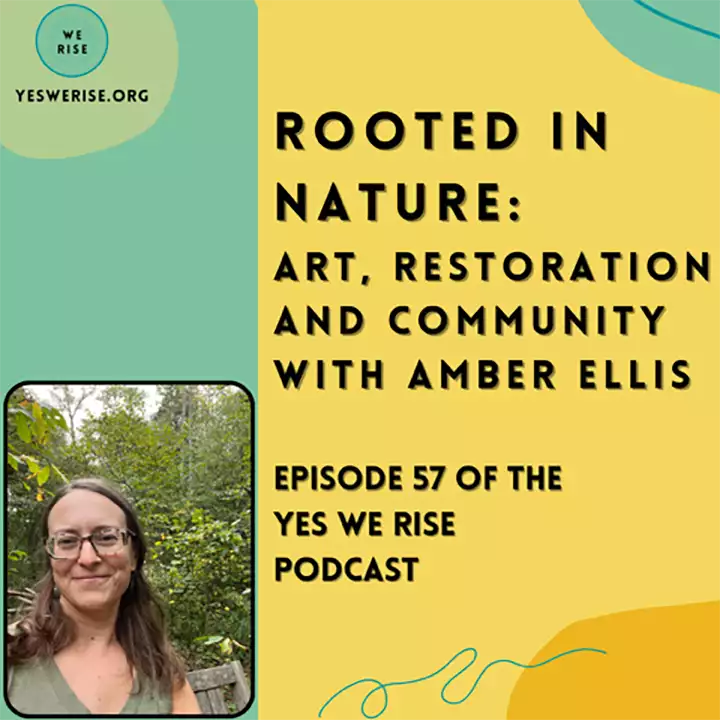
Rooted in Nature: Art, Restoration and Community with Amber Ellis
Episode 57 of the Yes We Rise podcast
Transcript
Christine Gyovai (00:00)
Amber Ellis, welcome to the We Rise podcast. Really glad to have you on today. Thanks for joining me in time.
Amber Ellis (00:05)
Hi Christine.
Christine Gyovai (00:06)
Yeah, I’m glad you’re here. So Amber, we’ve worked together for several years now and I’m just really excited to have a chance to share with folks more about who you are and the work that you do both with the James River Association, Find Your Nature, your work with Nature Connection. And I think the work that you’re doing is really important. Tell us a little bit about yourself, your story and your background. How did you get to doing what you’re up to today?
Amber Ellis (00:29)
Yep, so I grew up in Powhatan County, Virginia, so haven’t strayed far from home. I live in Richmond now. So grew up with a pretty rural upbringing. My parents still live in the same house that I grew up in, so I still get to go there, see the stream, see the woods behind the house that I used to spend my time in. So that’s where I grew up, and it was a county that was very rural when I first
maybe until I was in my early teens and then started really, people started moving out there. We got our first stoplight when I was 13. So saw a lot of changes and I think that’s what wanted me to get into like environmental work. I was seeing the landscape around my home change and wanted to know what I could do. So that’s where I started.
Christine Gyovai (01:03)
Uh-huh.
Hmm.
Yeah.
And tell us a little bit more about what it was like. I know you’re going to tell us more about your story, but how did you, like, were you running around in the streams? you, like, in the creeks? Like, tell us a little bit more about what you were up to in those woods behind your house.
Amber Ellis (01:29)
I don’t even, I would just follow it to the lake. There’s a lake in our neighborhood. For some reason, my parents would always buy us white tennis shoes and they would always end up orange. First of all, particularly remember, I specifically remember one pair that I came back and I’m like, don’t know. So, getting my shoes dirty, just sitting back there. There was a big tree that had fallen and me and my neighbor would just sit there.
Christine Gyovai (01:39)
All right, yep. Yep.
I love it. Yeah.
Amber Ellis (01:57)
and hide out. Like it felt safe because we could see home, but it felt like our own little spot away from the world to just hang out and talk. So just hanging out, which is what I still like to do is just run around and see and explore. And other than that, I would play with Barbies and then play in the stream. Those are my two and I feel like that’s my life now.
Christine Gyovai (02:18)
Mm-hmm. That’s awesome.
Still Barbies and still the stream. Yeah.
Amber Ellis (02:23)
It’s like humans, people, people
in relationships and that kind of stuff and trees and water. Those are my things. Yeah.
Christine Gyovai (02:31)
Yeah, yeah,
I love that. And how does that show up in your work today? The trees, water, people and relationships. What are you up to today now that you’re, after you turn 13, you talk to at that age.
Amber Ellis (02:38)
Yeah.
Yeah, so I, after I graduated from high school, I ended up going to school for landscape architecture at Virginia Tech, which again is still about people and the environment continues to be the case. then, slowly kind of landed where I am, worked at an engineering firm.
for a couple years and was volunteering for environmental work, but wasn’t doing it for a living necessarily. And so I took a big step to become just a part-time intern at James River Association. And then I’ve been there for, it’ll be 15 years this month. So yeah, it shows up, I didn’t always do riparian forest buffer work.
Christine Gyovai (03:18)
Mm-hmm.
That’s so cool. That’s awesome.
Amber Ellis (03:28)
At JRA, I started with more volunteer coordination, trash cleanups, plantings, sometimes doing design for smaller landscape. then slowly kind of steered the ship towards riparian forest.
Christine Gyovai (03:41)
Yeah. What is a riparian forest buffer? I know that we use that work and our shared work for folks who don’t know what that means. Tell us what that means.
Amber Ellis (03:48)
The trees, the shrubs and trees and vegetation along our waterways. They’ve always been my favorite place to hang out as I shared in the beginning. And so they hold a special place for me. And so it’s important that I continue to find ways to work with our partners to restore those areas, to protect them, to connect people to them.
Christine Gyovai (03:56)
Mm-hmm.
Yeah, I love that. I want to round out a little bit more about the work that you’ve grown into in the last couple of years too. You create beautiful art. Tell us a little bit more about ways that you connect with nature and that you offer ways for folks to connect with nature too. And then we’ll come back to the buffers in a little bit.
Amber Ellis (04:23)
Yep. So my connection, I’ve had it since I was a kid and then continue to find ways to connect to the natural world, where I feel most at home. It’s where things make sense for me. So for me, that looks like it could be as simple like every day, I can’t go somewhere to the top of mountain somewhere, but I can go sit on my, in my yard. I can do a loop around the block.
when I have time maybe every weekend or over the month try to go to a local park and walk around just finding ways to connect to the woods of our in Richmond things like that. How else do I connect to the natural world? Just I think the difference people go outside but I think the difference in connecting to it for
like more mental health or for me it’s like a spiritual health, is doing it with some intentionality and not trying to get somewhere quickly, but just taking a pause out there and watching the things around us.
Christine Gyovai (05:24)
Yeah, a little bit about find your nature and some of, you use also art, it seems like, as a way to share your connection with other people too. Love to hear more about that.
Amber Ellis (05:35)
Art is another thing. feel like for me, there’s different things that have helped me stay centered over the years. Art, connecting to the natural world and then some kind of meditation or quiet time, basically. Art, I wouldn’t say I’m an artist artist, but it’s just, I love doing it and not for the sake of creating something, but it helps me like see better. It helps me understand better.
Christine Gyovai (05:47)
Mm-hmm.
Amber Ellis (06:00)
I guess is how I use it. So that could look like, I in a specific example back in the fall, I was outside along the river. At first glance, things might seem just like brown and gray. But if you really sit and actually look, not like, I’m looking at a tree, but just really taking in the textures and the colors. Just doing little, just took out my watercolors and created little squares and tried to create the colors that I was seeing.
Christine Gyovai (06:01)
Beautiful.
Amber Ellis (06:25)
around me and then all of sudden you realize, it isn’t just brown. There’s actually all sorts of colors, right, you know, within 20 feet of me. So like it’s just a way to really see, I guess, how that I use art, both both that and then it helps me understand sometimes what’s going on in my own life. If I start to draw it out, I’m a very visual.
Christine Gyovai (06:37)
Yeah.
Mm, mm, that’s neat. it almost sounds like another way of seeing, another way of connecting and making sense of the world to some degree too, taking time to pause and go deeper. Yeah, beautiful.
Amber Ellis (06:49)
Mm-hmm.
Yep. And it helps me
remember those. Like if I go on little trips, will, I could take pictures all day, but if I sit down and draw something, I will remember that moment much more, like vividly, if I took the time to really see it.
Christine Gyovai (07:11)
Yeah.
I want to dive in a little bit more about what that looks like in terms of seeing a place or experiencing a place. And also something, Amber, that you talked about earlier about feeling at home in nature and things make sense there. One of the things that I’ve both heard and experienced with people is that the perceived separation from nature is one of the things that
really causes a lot of challenges in different ways.
What does your practice of art, if you will, or of creation, how does that deepen your relationship with place? Or what does that feel like to feel at home in nature? Because I know what you mean, but if someone’s like, I don’t totally feel at home in nature. I don’t know how to feel at home in nature. How do I start? Can you talk a little bit more about what that looks like for you, and then what that might look like for other people in terms of building that relationship?
Amber Ellis (08:03)
Right, and I’m not, I say that and people are like, that means mean that she loves to just camp out. I still get, I don’t like camping. I get scared. I don’t love being out in the woods. I still have fear of all of those things. So I think saying at home doesn’t mean always comfortable.
Christine Gyovai (08:09)
Mm-hmm. Mm-hmm.
Sure.
Amber Ellis (08:24)
but it feels for me when I go out, there’s this…
It might sound cheesy, but like the things in nature, the birds, the trees, they’re all just doing the things they do. They’re just doing, they’re doing the thing they do every day. And it somehow gives me permission to do the same. Like there’s this, when I’m out there, like the tree isn’t like, well, what is she doing sitting there like that? Or there’s this, I don’t even know to explain it, an existence that we’re there. I’m there with the birds or the trees or the grasses and we’re all.
Christine Gyovai (08:49)
Yeah.
Amber Ellis (08:55)
just allowing each other the space to be and whatever that might be. Yeah. ⁓ and so I don’t have to show up in a great mood. I can show up not feeling like myself. I can show up angry. I can show up sad, but I can also show up happy and excited to be there. Like it accepts me in whatever way that I am. Yes. Yeah.
Christine Gyovai (08:58)
Mmm. That’s beautiful.
Beautiful.
Amber Ellis (09:21)
And then I find things that…
feel like if I quiet enough.
Like there’s an unspoken.
hate to even say conversation because it makes it like a human thing, there’s like, that’s, don’t know another word, but like a unspoken conversation that I can have with the natural world. it.
I’ll just see things or observe things or certain animal may come around a lot and makes me look at something I might be dealing with my life in a different way. Or like, I have this problem at work. Well, how does blank and how does things outside deal with that issue?
Christine Gyovai (09:45)
Mm-hmm.
Mm-hmm. Yeah.
Amber Ellis (09:53)
Yeah, or gives me comfort around just life itself of birth and knowing that one day I won’t be here. Like it brings me a lot of comfort to be out there to see that happening around us all the time. And that it’s not just me, it’s everything. We’re all going through all of that together, not just humans, but everything that’s living is going through those same cycles together, is comforting. Yeah.
Christine Gyovai (10:10)
Yeah.
Yeah, beautiful.
Yeah, I love that. you know, allowing each other the space to be, you talked about like the birds and trees are just, you know, they’re there and you can show up however you are in whatever space you’re in and just be in whatever the space that is. And you didn’t use the word teacher, nature is teacher, but you did talk to some degree about the pattern that you’re observing or what’s coming and using that observation in your own life, whether that’s work or moving through something.
And I also hear curiosity. You you’re paying attention, you’re watching, you’re listening, you’re using different senses to explore what’s happening in the world. And then you’re open to receiving, you know, what it is in nature. Yeah, beautiful. Do you have a favorite spot these days that you like to go sit or to be or to hang out?
Amber Ellis (11:07)
So it doesn’t, that’s my message for anyone is it doesn’t have to be complicated. You do not have to climb to Mount Everest to connect. My favorite place right now is probably, I have a little balcony off our second floor here on the other side of my office that I like to go sit on. Yeah, that’s easy, accessible. Like I don’t have to get in the car to get to it. I just walk outside.
Christine Gyovai (11:10)
Mm-hmm. Mm-hmm.
Right? Yeah.
Mm-hmm.
Beautiful. So you’re just outside hanging out observing. Yeah.
Mm-hmm.
Amber Ellis (11:35)
So that is helpful. And I’m trying to read, feel like over the past few years, my connection with the James River Park system here in Richmond has not been, I haven’t really been going there much. And so recently I’ve been trying to get back there just to re-explore and.
Christine Gyovai (11:51)
Such a beautiful park system. goodness, if folks have not been to Richmond’s park system, it’s really such a great interconnected ways to play in the city connected downtown, river trails, topography, urban, fields, rural, sometimes really amazing landscape. So Amber, tell us a little bit more about how you maintain your connection with nature. Do you have an ongoing practice quarterly?
Amber Ellis (11:52)
Thank
Mm-hmm.
Christine Gyovai (12:17)
because you bring intentionality to both your work and to the way you maintain that connection. What does that look like in your own life?
Amber Ellis (12:24)
Yes, so it is intentional. I feel like I’ve got one life I want to like I want to I want to make it as it’s the art thing against creating a life that I want to live. But yeah, for me, I already mentioned kind of daily practices and weekly but one that I started maybe I think was around 2020 actually.
Christine Gyovai (12:29)
Yeah.
Mm.
Amber Ellis (12:48)
is with the season. have my own name, they’re my seasonal soul sessions. I do them at the change of each season. I do a longer one around New Year’s and then, and the end then one in spring, summer and fall. And I’m fortunate I have a place. We have a place out in Buckingham County where I can go out in the woods and again, just be, I am, I use those to just,
I just have like quiet time by myself to check in on how I’m doing. So it may include some meditation, like more than normal, eating really nutritious food, like caring for myself. I’ve struggled with anxiety for like 20 years and finding ways to be kind to myself is really important. And so I use
Christine Gyovai (13:36)
Yes. Yeah.
Amber Ellis (13:38)
those times to do that and asking myself what is it that I need during that time and then creating a day or a weekend that is going to support that. So it could be some art, but I try to keep it simple. Again, I don’t need a ton. I just need to be quiet. So I don’t usually try to fill it with a ton of stuff, but fill it with things that are nurturing.
Christine Gyovai (13:49)
Mmm, beautiful.
And I love that you just talked about being kind to yourself, Amber, that it’s not something as a society that we often do and we don’t ask the question, how can I be kind to myself today? So you’ve built in a practice, whatever space that you’re in to say, how can I be kind to myself? How do I keep it simple? How do I keep it quiet? How do I nourish myself? What’s gonna bring me wellbeing? How do I care for myself? That’s really beautiful.
And how has that, has that practice changed over time for you? Yeah, do you know?
Amber Ellis (14:33)
Yes. Yeah, it
has. I’d say in the beginning, was like, felt like I had to be a certain way. Like it had to look a certain way or something. was like, what are you doing? just no. Like how much do I need to fit into this? Or there were moments where I felt like I had to use it to still be productive in some way. Like I would take things to work on or.
Christine Gyovai (14:40)
Mm-hmm. Yeah.
Right.
Hmm.
Amber Ellis (14:57)
But even that is slowly shifting. like, no, you have plenty of time to do all of that. And then over the season, different seasons look different. Sometimes, like some of them, it would be very quiet, serious. Other times, have, I remember very clearly, I just wanted to hang out in the baby pool and have water color and drink smoothies. And like that’s what I did. Yeah.
Christine Gyovai (15:17)
I love it. I love it. That was it. Period.
There’s nothing else to say. Just period. That’s it. Yeah. I love that. I love that.
Amber Ellis (15:25)
It was hot, know, like summertime. I was like, I just want to be in water. Like it’s so hot. so again,
but just like giving my permission, like you can do that. Absolutely. So they, I know it was the best weekend and there’s no one there to tell me I can’t do it.
Christine Gyovai (15:38)
That’s awesome. That’s such a great image. It’s so great.
Yeah, let’s do it.
Amber Ellis (15:46)
and, but then other times have been a little more focused. ⁓ an important thing for me was identifying what my values are in life in the world so that I can check on, check on myself during those times. Like, am I leaning into those? Am I not?
Christine Gyovai (15:56)
Mm.
Mm-hmm.
Amber Ellis (16:06)
Yeah, those, I think those, I have five, I think they still hold true.
They are community stewardship.
spirituality, authenticity, and competence. That last one was a hard one for me to come by, but I realized when thinking about my values, one is like the things that bring you joy and the things you see, but that one came about was like, when do I get really upset? Like when are my, do I feel like somebody who just pushed a button where I get angry? And I’m like, that is also showing me what is a value for me.
Christine Gyovai (16:29)
Hmm.
Mm-hmm.
Amber Ellis (16:39)
And the competence one, when that’s questioned, like if my…
Christine Gyovai (16:39)
So awesome.
Amber Ellis (16:43)
Or if I’m, and this is a hard one for me to remember through a lot of my work, is if I say yes to too many things and overload myself, I have to remind myself if I do that, you’re not gonna do a good job. And then you’re gonna be upset that you’re not doing a good job.
Christine Gyovai (16:54)
Mm-hmm. Mm-hmm. Yeah.
Yeah. Want to do the things but can’t do all the things because you still have the, you’re being kind to yourself but you have this awareness. So you have these guideposts, if you will, these five values that you’re checking in on and it sounds like it’s a practice for you to come back to them. They still ring true for you. So you’re not just assuming that they’re still true for you but then you’re also looking out to see
Amber Ellis (17:01)
Mm-hmm.
Christine Gyovai (17:18)
Where am I getting activated? Where do I need to kind of come at it from the back end? Yeah, so smart. And how does that show up in your seasonal soul sessions? Are you kind of checking in on them? For some people, the practice of identifying what your values are, you and I have spoken about Brene Brown quite a bit over time, and certainly organizational values are something that folks talk about, but we don’t.
talk as a culture about our own individual values and use those as something to be mindful of and heartful of and to use them as kind of guideposts for living. So can you talk a little bit more about how does that show up in your everyday life or your seasonal soul sessions?
Amber Ellis (17:57)
Mm-hmm. I do check in on myself with those during those times. And then in my work, I’m fortunate that I work my work and the organization I work for, think I share community is one that I share with James River Association. And then a lot of these are through our Riparian Consortium and other work.
How would I answer? Like, my work is important to me, but I can’t control all of the things that happen at work and I can’t.
Like let myself feel like I didn’t succeed at it because something didn’t work out. But I can make sure that I’m, that I’m showing up aligned with my values. then I know that at least I did that and I will feel it’s like a different version of success. Like was I able to continue to lean on community, engage community, even in times of stress or
Was I able to show up as myself? Was I able to create that space for other people to show up as themselves in those situations? if I’m doing those…
If I’m leaning into my values and giving space for other people to do the same, I feel like I can better trust, I don’t know, the process and where we’re going.
Christine Gyovai (19:09)
Yeah,
yeah. So it’s a different definition of success, but you’re also knowing that you’re clear on what you bring. it also sounds like bringing the, you didn’t say this, this is something I’ve been thinking a lot recently about intrinsic worth, feeling a sense of worth intrinsically, because you know what you’re bringing and that you’re showing up as much as you can being mindful of what those values are to the work. And so you have your own internal kind of guideposts that are helping to shape the work. It’s really beautiful.
Thank you for that. So Amber, tell us a little bit more about what does your work look like with community? You talked a little bit about a few projects in the James River Association. Tell us about what your restoration work looks like and how you engage with community.
Amber Ellis (19:48)
Restoration work. ⁓ man, it’s a lot of partners, a lot of good work going on. If I had to explain what my job is, it’s.
Christine Gyovai (19:52)
Mm-hmm.
Amber Ellis (19:57)
listening, lot of listening to our partners, to also to the environment and to the river and what’s going on there. And then arranging or help kind of make sense of all of it. Like, I feel like that’s my role and a lot of it is hearing it and then being like, okay, let me try to figure out some way to take this from just
Christine Gyovai (19:59)
Mm-hmm.
Mm-hmm.
Amber Ellis (20:21)
people complaining about X to moving it into action, but not just something I’m doing, but like, how can we turn it into action with all of these folks and make it easy for them to participate and be part of the solution? So that gets messy.
Christine Gyovai (20:33)
Mm.
Mm-hmm. In what way? I mean, yes, but… Mm-hmm.
Amber Ellis (20:40)
no, there is no timeline. There’s no, like,
and there’s no, have to be able to sit in those spaces and be like, well, we don’t know where it’s going to go. We’re going to figure that out together. And that takes, I think a lot of people are used to people telling them, this is what we’re doing. This is where we’re headed. ⁓ and so I think it’s new for a lot of people to be like, wait, we’ve got to, we’re part of the figuring out where we’re headed together.
Christine Gyovai (21:04)
Yeah, beautiful. So you’re holding space to some degree too in this restoration work. And I know we’ll have more conversations about the Upper Middle James Riparian Consortium, but you do such a beautiful job as the convener for that collaborative and for folks who might not know, this is a large initiative across middle and western Virginia to get more buffers on the ground, but really to improve partnerships, make connection, build relationships and trust and Amber.
Amber Ellis (21:07)
and
Christine Gyovai (21:31)
in her role as the restoration director at the James River Association as the convener. So I was really doing what you just said. I love that you talked about listening to the river and you’re helping people find ways to be part of the solution. That’s really beautiful. What have been some of your lessons learned through that work?
Amber Ellis (21:48)
I think.
One that I knew upfront, so I helped myself, was like setting up the systems and the infrastructure as though you’re going to succeed. Like go in thinking this is going to be around for 20 years. So we have our Danger for Buffer program where we work with hundreds of landowners to restore these streamside forests and we take care of them.
Christine Gyovai (21:59)
Mm-hmm.
Yeah. Yes. Yes.
Amber Ellis (22:16)
for three years and that started in 2019, but we set up, we went through like, how are we gonna do the coding for these sites? How are we gonna save all the information? Like, how are we going to set up the infrastructure in case it is a huge success, which it has been, so that we can keep it going and have access to all this stuff. So a lot of my job is the kind of behind the scenes system side of it.
Christine Gyovai (22:43)
Yeah, And I love that you just said we’re not thinking about whether we’re gonna be successful. We’re just setting it up now to be successful, thinking about what it’s gonna look like in 10 or 20 years. you also, you do it in a very humble way, but you’re well loved by many, many people for doing the work and you do it with heart and integrity and intention, you know.
So you’re listening to the river, you’re bringing people together and you’re thinking about what systems are in place so that people can feel part of it in a way that’s reflective for them. It doesn’t have to be this external thing that people have to fit into you, we, others are creating spaces where people can feel comfortable kind of as they are. So I wanna broaden it out a little bit to community and then come back to you. When you think about the restoration work that you’re working on and the…
Amber Ellis (23:21)
Mm-hmm.
Christine Gyovai (23:30)
This broader work to improve water quality in the James or connected ecosystems, big trees, clean water. What changes have you seen over time in Virginia and in the Chesapeake Bay within the restoration work and what makes you excited about what you’re seeing?
Amber Ellis (23:46)
I feel like I have seen a shift from.
sense of like competition for grants or for space or just and instead people coming and showing up and be like, okay, where is my niche? Where are the gaps? What can you do? I do as part of this, like it just a shift and trying to do it alone and realizing that we can do more together. I feel like I have seen that.
Christine Gyovai (24:13)
Yeah. And it does, people show up, more people show up to do the work, they can see the value of it. Yeah. And when someone feels like they don’t know how to engage or when they feel maybe nervous about engaging with a group, how do you help them engage? How do you help keep the door open for them when someone might feel a little overwhelmed or intimidated by some of these larger initiatives?
Amber Ellis (24:18)
Yep. Yep.
I think the easy answer is just like a one-on-one. Yeah, yep. In person if you can. I try to make it just finding ways to interact with people in a not formal, necessarily formal environment. Like if I’m heading to an area for some other meeting and there’s a partner maybe I don’t know well, like.
Christine Gyovai (24:39)
Yeah, just talking with folks.
Mm-hmm.
Amber Ellis (24:58)
Do they want to go to lunch or something like that? Just ways to get to know people.
Christine Gyovai (25:04)
You’re those connections, you’re building relationships and that shows up in the work. What else are you finding with your work with the restoration with buffers, with partners? What other kind of changes are you seeing on the ground? are you observing, changes in ecosystems or in trees or are you thinking like how have you had to adapt the way that you’re planting trees now?
Amber Ellis (25:08)
Yeah.
Christine Gyovai (25:27)
And what are you seeing with some of the on the ground restoration work that you’re thinking about building success into the future?
Amber Ellis (25:33)
Two things come to mind. One is I feel like we have a massive group of partners now that are shouting from the rooftops about maintenance, that it’s not just about planting a new tree, it’s about taking care of them. So I feel like that has been a big shift. And I feel like funders and folks are listening to that and hearing what we’re saying. So that’s good. And then the other part of that question is,
Christine Gyovai (25:41)
Mm-hmm.
Amber Ellis (25:56)
riparian ecosystems just by default are in a very, I don’t know what the word is, but they’re in a changing landscape. They’re in a region that’s going to be hit by floods and are always changing. Like that’s just how they are. That’s what they’re great at also is dealing with that. But until those trees grow, because we plant them when they’re little, until they get big,
They’re really susceptible if a big storm comes through. And so we’ve been trying to come up with solutions to that. Because just in the past six months, there’s been pretty significant flood events in the area that we work. So we get calls from landowners. All of my tree tubes are down. What are we going to do? So we have to have a plan to how we’re going to deal with that.
Christine Gyovai (26:49)
And how are you dealing with that? I’m going back to that patterns, patterns in nature, you know?
Amber Ellis (26:54)
We are, we are just this week, actually, we’re going to look through it. We came up with, it’s the greatest pun ever, a triage survey. We send out, it was amazing when our team came up with it. It was a moment of clarity, but sending a survey out to our buffer program participants after a significant flood event just to check on them and to see.
Christine Gyovai (27:04)
night.
I love it.
Amber Ellis (27:19)
What kind damage did they see? And then we can review that together to come up with a plan. Okay, how many sites, how bad? Can we get some volunteers out there? Do we need to get a contractor out there? And then figure out what resources we have to put towards it.
Christine Gyovai (27:33)
Yeah, awesome. So you’re checking in, you’re following up with resources, you’re getting to know people and you also know what the partners are on the ground. And again, one of the things that you do so well. So when you think ahead down the road, five, 10, 50 years maybe even for the buffer work that you’re working on and the other restoration work, what are some of the things that you hope to see in Virginia, in the James River watershed, in the Bay? What’s more of your vision for the future?
Amber Ellis (27:41)
Thank you.
Hmm.
Funding is on my mind right now. It just does. And I think I can’t ignore that. think my one vision is that.
Christine Gyovai (28:00)
Mm-hmm. Mm-hmm.
Amber Ellis (28:05)
funders continue to see the value in supporting.
the things that aren’t always flashy or new, like the consortium and just like the funding for collaboration, the people to keep people connected, the food to eat at the events and meet and gather. So I hope to see a continued and more stable source of funding for such a role that people play. I would say that.
Christine Gyovai (28:20)
Mm-hmm. Mm-hmm.
Yeah, absolutely.
Amber Ellis (28:36)
and
Even as things get better and we see improvements, just not letting off and being like, well, that’s good. That’s taken care of now. We’ve got enough trees on the ground, but continuing to, to invest in those resources and invest in programs like our buffer program, as well as the maintenance of them, the stewardship program that we have started, just not forgetting all of this work that’s happened and continuing to care for them and hopefully.
Yeah, that would probably be my two of mine supporting the collaboratives and caring for what we’ve put in the ground over the past couple of decades.
Christine Gyovai (29:10)
So true.
So two things, Amber, you mentioned funding for the work, even not necessarily the new sexy work, but the ongoing initiatives, being able to fund people coming together, people that eat food and then the maintenance for their work, continuing to keep the trees healthy and growing. And you just mentioned funding, which is something that many organizations, agencies and other folks are wrestling with right now, shifting funding landscapes and…
I’ve been talking with people about how relationships are like trees to some degree and what do trees look like over time and what do they need and they still need sunlight, they still need water, they still need nutrient sources and then connection with other people. So that analogy of continuing to tend relationships like a forest, like trees has been something that’s been on my mind a lot. So yeah, I appreciate what you just said. The things that will be needed in the future are the things that are needed now.
it’s not necessarily some great big different thing. It’s what we’re up to on an ongoing basis thinking about how to continue health for the long term.
Amber Ellis (30:11)
Okay.
And
if you’re connecting those networks of people, we’re able to kind of hear what those new things, those new issues are coming up so that we can adapt and address them together. think that’s what it does. One of the best things that it does is keeps us all on the same track, like, you’re seeing that too. we’re seeing that too. This is a new thing. So by doing that, we’ll be prepared in the 50 years. Who knows what will come up?
Christine Gyovai (30:34)
Absolutely.
right. I’m thinking, Amber, as you’re talking about that, the book Overstory comes to my mind, with a lot of the ideas in it of tree roots being connected like mycelial networks. And so when one part of a forest is stressed, you know, sending a signal to another part of the forest, and that’s one of
Amber Ellis (30:39)
that time.
Christine Gyovai (30:55)
points of beauty of collaboratives is
When you have relationships that have been formed, when something gets stressed, you can reach out to other parts of the collaborative and help do problem solving together. recognizing that things aren’t always easy, that they are messy sometimes and they are difficult. But having that network in place lets people respond together to some of those challenges.
You talked earlier about some practices that you have in place to keep you connected, where you’re in nature feeling at home and centered, I wanna bring it back to joy. You mentioned joy earlier, and I wanna ask you a little bit more if you can tell us what are some of the things that bring you joy
Amber Ellis (31:35)
Hmm.
go in depth, but my cats, my cats. This time with that could be dogs, cats, just animals in general. movement. I have to move my body. Yeah, to, to stay feeling good and
Christine Gyovai (31:39)
Mm-hmm. Yeah.
Mm-hmm.
Amber Ellis (31:56)
I found a place in Richmond, that brings me joy. It’s called Made in Motion, shout out to them. We do barre we do dance, sometimes it’s silly. And it gives me a place to interact with another community of people outside of my house. work at home a lot, yeah, movement.
Christine Gyovai (32:00)
Yay.
Yes, absolutely. It’s so important. I think we’ve probably talked in the past about how much I feel like in my own life I live for probably the first three or three and a half decades of my life from my neck up, know, very cerebral and thinking and planning. And it wasn’t until I hit, you know, I’m 47 now and it wasn’t until I think I was about 35, was like, whoa, there’s a lot of wisdom in my body. Whoa, and I prioritize movement.
Amber Ellis (32:34)
Mm-hmm.
Christine Gyovai (32:36)
I respond to the world differently and I respond to the world with choice and I don’t get stuck in these narratives like old narratives, they’re there for a reason but I can tune into my body’s wisdom in a totally different way and it’s really shifted how I respond to the world. I’m so thankful for it and love that you brought up movement. It’s such a core thing.
Amber Ellis (32:54)
Yeah. Yeah.
I need to bring out my hoops again. I haven’t done that in a while. That used to bring me a lot of joy. It would give me something new to learn when these are hula hoops. Put on a song, dance around it. You can’t be upset. Like, you can’t. Yeah. And even when I dropped it, I laughed that I dropped it, you know? Yeah.
Christine Gyovai (33:00)
Mm-hmm. I love that.
Mm-hmm.
Yeah, because you’re a little bit. Right. Yeah, that’s awesome. I love that.
Yeah, and you’re just activating a different part of who you are and you’re cultivating that by choice. Yeah, 100%. When I go to dance sessions, classes, often freeform, you know what, things really do move. They shift.
Amber Ellis (33:21)
Yep.
Christine Gyovai (33:33)
and I don’t have to do anything. I’m just listening to my body and listening in and things change and I’m so grateful for that, that there’s a way to be able to create change in movement.
So I want to ask, either in your own work or your work with community, what are some other lessons that you’ve learned? You talked about some of the learnings with community and collaboratives. What are some other key lessons that you’ve learned that you want to share with others, with folks who are trying to make change in their communities and regions?
Amber Ellis (34:00)
I say this right, like around the listening part. Early on in JRA and even in college, I’m always interested in the listening to community, hearing what’s going on to inform the project.
But some of those projects taught me more lessons than I knew that I was getting ready for, but just.
community that you may be working in or part of may have been broken, trusts have been broken there and it’s going to take a while for them to even believe that you’re there for the right reason, that you’re really in it with them. So
Christine Gyovai (34:28)
Mm-hmm.
Mm-hmm.
Amber Ellis (34:38)
I guess just when people have that idea like, I want to do blank.
Christine Gyovai (34:42)
Mm-hmm.
Amber Ellis (34:43)
making sure that you’re engaging whatever stakeholders that work impacts.
But knowing what you’re able to do beyond that, like you can’t don’t engage people in a conversation and really have that space for them to share and be vulnerable if you’re not gonna take it anywhere. Because that is one of the worst things. It would been better to not have even asked. That sounds terrible, but it just.
Do you know what I mean? Like don’t even ask if you’re not willing to stay for the next step. Or if you are, at least be transparent at the front and acknowledge what you’re able to do and not able to do and what your intention is so that you don’t cause more harm.
Christine Gyovai (35:10)
Sounds right on. Yeah. Yeah. Yeah. Yeah.
Mm-hmm, wise words. Going in with what your capacity is, you don’t have to do it all, it sounds like, but knowing what you can do and what you can’t do. And so if you’re going to engage in a community, being clear at the onset with what that is, if you’re going to listen, be willing to follow up because otherwise it can create more harm than being productive, it sounds like, is really important. Very wise.
Amber Ellis (35:31)
Yeah.
Yeah.
Yeah.
Christine Gyovai (35:51)
Yeah, what else, Amber? If someone told you some whispers of wisdom five or 10 years ago, what do you wish someone had told you about this for? Or what would you pass on to others in a similar vein?
Amber Ellis (36:04)
Mm-hmm.
interesting the first one that comes to mind is just that you don’t have to do it all. knowing your role and being okay to ask others to help or to chip in is okay to do because people want to be part of the thing. Just like friendships, you want to do your part.
And it’s like a two way thing. So yeah, the relationship part.
Christine Gyovai (36:31)
Yeah, beautiful.
Asking, making space, following up. Human things, you know, we bring ourselves, but when we get stressed, it can be hard. And so, you know, you’re making space at the beginning for these things to be important and knowing how folks can be part of that. I love that you said people want to be able to be part of things. They just don’t know how sometimes.
Amber Ellis (36:47)
Mm-hmm.
Mm-hmm.
Christine Gyovai (36:52)
So Amber, tell us any other thoughts or reflections that you want to share and let us know how people can learn more about you and your work.
Amber Ellis (36:59)
Yep. And so, you mentioned a little bit at the beginning. So my main work is at James River association. I also started a, my own side business, ⁓ find your nature, which I’m still exploring. It’s kind of there for me to experiment and explore with, which I really love having. ⁓ so I’m working on programming for this year and listening to what’s needed so that I’m not just offering.
Christine Gyovai (37:09)
Mm-hmm.
Mm-hmm.
Amber Ellis (37:26)
just offering for the sake of offering, but trying to respond to what I’m seeing. So I’m excited to dig in closer to my own neighborhood. There’s a wonderful space nearby that I’m looking to use that already has great programming and people who use that space. So that’s findyournature.com.
Christine Gyovai (37:45)
We’ll definitely include a link to that in the show notes and description.
Amber Ellis (37:46)
Yep.
And then through the other links through James River Association, they can find more about what I do there.
Christine Gyovai (37:54)
Yeah, awesome. Anything else you want to share today before we wrap up, Amber?
Amber Ellis (37:57)
No, thank you for taking the time to talk to me, Christine.
Christine Gyovai (38:00)
Yeah, it’s a delight. Always, always enjoy the work that we get to do together. And really I’m excited for folks to be able to check out, find your nature and just learn more about the way that you are bringing the intentionality to your connection with yourself, to nature and to work. So thanks for joining the podcast, Amber.
Amber Ellis (38:16)
Thanks, Christine. Bye, everyone.