Episode 58:
• Zikki’s journey is rooted in service and community engagement.
• Farming requires patience and resilience; it takes time to see results.
• Just Help Africa focuses on providing clean water and education in Kenya and Nigeria.
• Community involvement is crucial for the success of nonprofit initiatives.
• Art can be a powerful medium for storytelling and legacy.
• Personal joy comes from connecting with others and giving back.
• Facing fears and self-doubt is part of the journey to success.
• Starting projects, even when scared, is essential for growth.
• Trusting the people around you is vital for achieving your vision.
• Finding joy in your work can lead to a fulfilling life.
find this episode on youtube
Chapters
01:18 Journey from Kenya to the US
05:10 The Importance of Discipline
07:25 Farming in Kenya: Lessons Learned
13:56 Just Help Africa: Mission and Impact
19:05 Community Engagement and Partnerships
23:05 Personal Reflections and Joy
24:24 The Joy of Giving and Personal Fulfillment
25:35 Self-Understanding and Positivity in Tough Times
27:34 Navigating Feelings and Maintaining Belief
28:59 Facing Self-Doubt and Building Trust
32:53 Art as a Storytelling Medium
36:13 Climate Sustainability and Community Engagement
41:32 Lessons Learned and the Power of Starting
Bio
Zikki’s commitment to community empowerment is further exemplified through his active support of local and international non-profits, including the Makindu Children’s Program, which provides resources to orphaned and vulnerable children in eastern Kenya, and the United Way of Greater Charlottesville. An advocate for blending art with technology, Zikki has embraced the digital art revolution by creating unique NFT collections. These digital artworks offer collectors exclusive pieces and contribute to meaningful social causes, reinforcing his belief in art’s power to drive positive change.
Through his multifaceted endeavors, Zikki Munyao exemplifies the transformative power of art, business acumen, and altruism, continually striving to make a lasting impact on communities both locally and globally.
From the Navajo Nation to the mountains of Appalachia, incredible work is being done by community members and leaders. Change is often sparked by inspiration: seeing what others have done, especially in similar situations and places. People see that when someone looks like them or lives in a place like theirs, and has created real, true and lasting change, change that will allow their granddaughters and grandsons to thrive — they begin to imagine what might be possible for them. No longer waiting for someone else to come and save them, they realize they are the ones they have been waiting for. But what creates that spark? What creates that inspiration? Learning through stories and examples, feeling a sense of agency and belonging, and getting fired up to kick ass creates that spark.
We Rise helps community leaders and members learn to forge a new path toward creating resilience and true transformation. One person at a time, one community at a time, one region at a time, the quilt of transformation can grow piece by piece until resilience becomes the norm instead of the exception. Together, we rise.
Links/Resources Mentioned:
The Yes! We Rise podcast is produced by Dialogue + Design Associates, Worthfull Media, music by Drishti Beats.
Follow Yes! We Rise on Facebook and Instagram.
Please rate, review, and subscribe to the podcast so we can continue spreading our message far and wide. Find our email list at the website: yeswerise.org. Thanks for listening.
Transcript
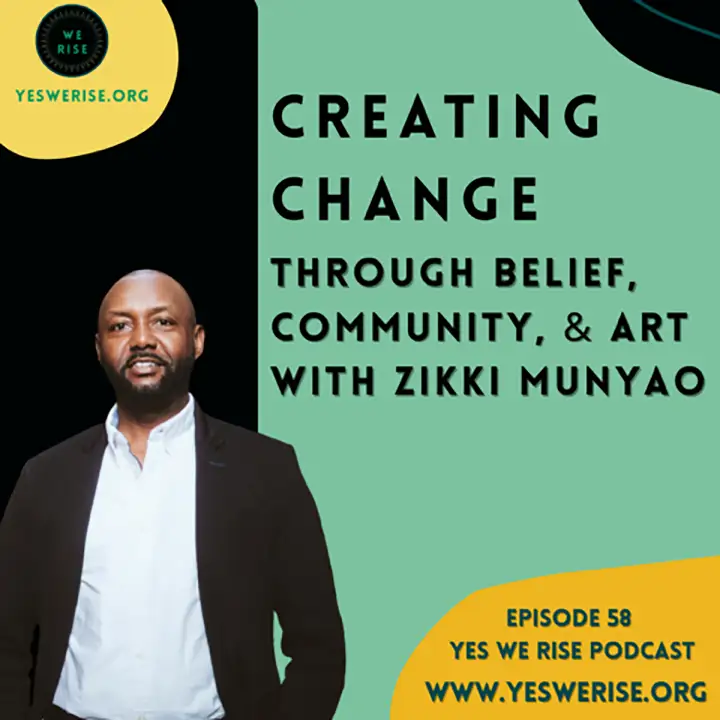
Creating Change through Belief, Community, and Art with Zikki Munyao
Episode 58 of the Yes We Rise podcast
Transcript
Christine Gyovai (00:00)
All right, I’m so excited to have Zikki Munyao on the We Rise podcast today. Zikki thanks so much for joining. I’m just delighted to be able to introduce you and your amazing work with listeners. So thanks so much for joining.
Zikki Munyao (00:12)
Thank you so much Christine for having me on your show.
Christine Gyovai (00:14)
Yeah. So you have such a beautiful story and the way that you share about yourself. Tell us a little bit about yourself and your story. How are you engaged with community?
Zikki Munyao (00:25)
Yeah, so I come from a point of service. Everything from being raised in Kenya, I was in the Cub Scouts as a kid in primary school. I was a prefect in high school, which kind of gave me responsibility over the students. I was a soldier when I came to the US with the US Army. I have been through UVA and kind of worked with different groups in there. And now I’m a philanthropist and I’m artist. over the years,
All that has come with a lot of lessons. just, you know, it’s been something of a journey that I’m looking forward to sharing more about.
Christine Gyovai (01:00)
You just summarized a whole lifetime in very few words. That was pretty amazing. That was pretty amazing. Unpack that just a little bit more. What took you from Kenya to the US Army to the University of Virginia? Tell us a little bit more about what that trajectory looked
Zikki Munyao (01:02)
It’s a lot!
Yes, so I’m born and raised in Kenya. So I left Kenya after doing primary and secondary school, living with a very big family. I come from a family that has polygamous members and we are pretty big but very close. So moved to the US in 1998 to do college and I’d won a green card which gave me the ability to do everything but vote.
So because of it, I was not that interested in school. I didn’t have the discipline or structure to kind of be disciplined enough to go to school. And I dropped out of school like within a few months of even getting here. So I the military and the military was a childhood dream of mine. And I wanted to pursue that dream. But within that dream was another of truck driving. You know, I’ve been driving tractor trailer since since I was 14 years old. So I’ve had a driver’s license since I was 14.
Christine Gyovai (02:06)
Interesting. Yeah.
Zikki Munyao (02:12)
and I’d been driving tractor trailers, tractors and all that, like heavy equipment was my thing. So when I joined the military, and I started off like, hey, know, like maybe I do truck driving. And they’re like, yes, we could use truck drivers. So they gave me the biggest truck you can think of in the military. So I drove this thing called the HET, which stands for heavy equipment transporter, right? And this thing has.
Zikki Munyao (02:38)
48 tires and carries m1 Abrams that you know the big tanks And I even have I even have a plaque, you know Because I loved it so much my sergeants thought that and they gave me a plaque when I was leaving the platoon But anyway for three years and two months. I served my three-year service with the US Army and I got out in 2002
where then I was trying to figure out what to do in the civilian world because now I have this discipline, I have this structure. So I then went back to school in 2003, did some community college just to see if I’m able to do this. Went through that successfully within a year as in UVA. I transferred over to UVA with an associate’s degree because education just seemed to flow well at that point.
Christine Gyovai (03:04)
Interesting.
Zikki Munyao (03:30)
And I got my undergraduate degree from the University of Virginia in English Language and Literature, and then moved on to a role in consulting. So I worked with a consulting boutique firm out of DC, where we were implementing systems for places like the National Institutes of Health. And then went on to GE. And just before going to GE, finished a master’s in the management of information technology, also at UVA.
Zikki Munyao (03:56)
And then from there, have been doing data analytics and healthcare, especially in the oncology space. But within the same timeframe, I got to understand philanthropy. You know, we started a nonprofit here called Cville Gives, which basically brings the community together through happy hours, where that kind of comfort of being around people in a very free environment.
Zikki Munyao (04:20)
allows for them to listen to nonprofits in Charlottesville and then they become members of Cville Gives and the membership dollars that we raised, it was $200 per person, $350 for a couple, we’d raise money from this membership and at the end of the calendar year or the calendar year for the nonprofit, give 100 % of it to the groups that we determined by the group that
Zikki Munyao (04:48)
this money should go impact. And we were raising an average over $20,000 per year. And I was like, you know what? This is going somewhere. So that’s what’s led me then to where we are today with Just Help Africa and living in Charlottesville. This is our home in the US. And then we also do some farming in Kenya. So we spent time in Kenya and here in the US.
Amazing. There’s so much amazingness in what you just shared. I want to come back to farming in Kenya in just a little bit and to hear if you’re close to where your family is and a little bit more about that connection. But Zikki first I want to go back to what you talked about, discipline. That’s not something that you hear a lot of people talk about, a conscious decision at a certain point in life to become more disciplined or engage with something. It’s something that most people have to … to utilize at some point in some way, but what did that look like at that kind of tender age? You’ve been driving since you were 14. You decided that you needed to buckle down in some way. What led you to that and what did that look like for you, that tenacity, if you will?
Zikki Munyao (05:52)
Yeah, I think from a young age I was always fairly disciplined because as I mentioned, I was in the Cub Scouts, I was a leader in my classroom, was leaders in teams. However, moving to the US, I had this freedom to do whatever I wanted to do and my decisions were very off. I just wanted to go party and have a good time, never go to class. The priority was not there.
Zikki Munyao (06:17)
So I knew I needed some discipline and I was not in a position to say, I am going to find a specialist who’s going to help me find this discipline. was like, there has to be a way I can get this discipline because if I get it, then I will simplify a lot of the things I do with my life moving forward. So I was like, if I was gonna make a chance to make this change, it had to be that time. So when I sat down with the recruiter,
I was like, I don’t know what I want to do, but I know I want to join the military because I’ll come out of it with some discipline and it’s something I’ve wanted to do. So there I was. I joined the military and by the time I finished basic training, I can tell you I had a lot of structure and discipline. Yeah.
Christine Gyovai (06:48)
I imagine so. So you had clarity that you knew this was a path that you wanted to take to some degree for an outcome. And you’ve continued to do that in different ways. So tell us more about farming in Kenya, what that looks like now, where. And then tell us a little bit more about Just Help Africa. we’re going to get into your beautiful art as well. But tell us a little bit more about what you’re up to in those two arenas.
Zikki Munyao (07:26)
Yeah, so Kenya and then Just Help Africa. Farming is all those things you get into if you’re looking to gamble.
Christine Gyovai (07:33)
Hmm. Right. Yeah.
Zikki Munyao (07:37)
Right? It’s kind of like
one of those things you either stay with it long term or you just don’t get into it if you know what you’re getting yourself into. So we’ve been at this now for three years and like deeply into farming for three years. We’ve been farming as a joke, you know, like, we have mangoes, January, we’re going to sell some mangoes, but we just planted those and they kind of work on their own on our land. This is family land that I have my home in, but we’ve bought now like
literal our own farm where we farm onions. That farm has been a labor of love. Right? That farm clearing it, planting the onions. We started off with garlic, which failed miserably. Right? The lessons learned from that allow almost like the lessons you need in life to wake you up. It’s kind like a really hard slap on your face to get things right, every single time when it comes to farming. But then there’s things that you can’t control. You can’t control the weather. You can’t control pests. You can’t control weeds. These are things that you have to learn from the experience. And that’s what farming has taught us. But now in year three, because we’ve learned all these things over the years, we feel that now the profits are things that we can realize because we know the process. So.
Christine Gyovai (08:55)
Mm-hmm. Mm-hmm.
Zikki Munyao (08:57)
It’s
been a labor of love and I would tell anybody who’s getting into farming, give yourself like up to five years to get what’s happening because it’s not just something that you start and you’re instantly profitable. It’s a process of learning. So that’s the farming. Any questions around that before I go into just help?
Christine Gyovai (09:04)
Well, who’s the we behind the farming? And I’d love to hear some of the lessons learned you talked about to wake you up. And I know we’ll come back to just help Africa, but yeah.
Zikki Munyao (09:24)
Yeah, so the
Wii is my wife Ruth. My wife and I have been married for about 21 years and my son Remy, thank you. Our son Remy, he’s turning 13 next Monday. So he has chicken on the farm, right? So he’s busy with those. He’s named every single chicken there is. And then…
Christine Gyovai (09:28)
Congratulations.
Zikki Munyao (09:48)
Ruth is the one that runs the farm so she can tell you the stories around it and the biggest story we can tell you around that farm or this too actually. The first is we started off this farm as a garlic farm. We’re to grow garlic because it does very well in those conditions especially the way it was written down for us the way it was prescribed to us was like ⁓ this makes sense you know like we can do this with our eyes closed right like they give us the seeds we grow the seeds we sell them.
Christine Gyovai (10:08)
Perfect.
Zikki Munyao (10:16)
make some money, makes it sounded very straightforward. When you planted the garlic, the garlic is very temperamental. Like any small change in conditions, the garlic does not do well. And the first thing that we realized right away is because this was the first time farming on this land in many years after we purchased it and cleared it, the soil was very, very rich.
Zikki Munyao (10:39)
So when you plant the garlic in there, the weeds that grew around the garlic was ridiculous. So every single week we had like a whole village in there, like weeding the farm. So the expense, yes, so the nutrients that was to go to the garlic were depleted over the time that the weeds were kind of competing for the same nutrients. So that was number one. And then that impacted the sales. So we didn’t have any sales the first time.
Christine Gyovai (10:43)
Right. The plants are ready to grow.
Zikki Munyao (11:07)
And then the second time we grew the garlic, we took care of the weeds with some herbicide at the beginning of planting, But then on the back end, somebody came and sprayed something at the end that killed it because they kind of added too much of the fertilizer that was supposed to go into the garlic and essentially killed our whole harvest, So.
Christine Gyovai (11:26)
And there it went.
Zikki Munyao (11:26)
And that was it. you know, we decided that garlic was just too expensive. So then we transitioned over to onions, which, you know, we knew those ones would do better and they’ve been doing well. But then we plant the onions, we take care of the weeding, we take care of the watering, we get to harvest. And as we harvest and the market is doing great. As soon as we take it to the market, the same week foreign onions had been brought in from Tanzania.
Christine Gyovai (11:53)
No way. No way.
Zikki Munyao (11:53)
flooded the Kenya market and took the price
from $2 a kilo down to 30 cents. So now we have the best onions, but the market killed it.
Christine Gyovai (11:59)
Wow.
which is the way farming goes. You plan, you adapt, you do the best you can and then something like an out of region onion comes in and takes sweeps the bottom out of the market. So what’d you do then? How did you, what have you continued to do with the farm since that time?
Zikki Munyao (12:05)
which is the way flaming goes.
Yeah.
So what we started doing is we started working with hotels and started working with different buyers. even the local markets started becoming an attractive place to sell these onions. So what we did then is we stored the onions for three months. Some people prefer their onions drier. So we dried them. We built a storage facility to hold the onions. And then we’re able to sell them.
slowly, like gradually to the markets and we sold that entire harvest, which was pretty significant, right? And then now as we planted, we’re hoping to harvest before the Tanzania onions come in and flood the market again. So now we are anticipating it. Yeah, so we planted a little bit off the schedule because we’re irrigating. So we don’t have to wait for rain, which by the way, right now it’s raining like crazy.
Christine Gyovai (12:47)
Okay.
You’re planning for it, right?
Zikki Munyao (13:08)
So that lessens our irrigation bill. But now we are hoping that by next month, the onion harvest will be in place where we can actually make some money before the June dump of the onions from Tanzania. Yeah.
Christine Gyovai (13:09)
So you’re learning, you’re iterating. So onions are still the primary thing that the farm is growing.
Zikki Munyao (13:29)
They are, we have bananas, sugar cane, papaya, we have peppers, we have many things on that farm, but the primary cash crop on that farm is onions. every time we harvest, we kind of cover crop it with like corn, beans, peas, sunflower. We keep it fresh,
Christine Gyovai (13:46)
Very cool. Yeah, I love it. I love it. So tell us about
Just Help Africa. Tell us more about why, how it got started, and what you’re up to with Just Help Africa today.
Zikki Munyao (13:56)
Yeah, so why? We just want to help communities in Africa in education and clean water. So we started this organization back in May of 2022 when Tunji Soroye who’s the founder of Just Help Africa, and I were sitting at the common house, which is kind like the co-working space that you and I usually frequent. And he told me about his story about how he used to get
Zikki Munyao (14:20)
cholera and waterborne diseases all the time because he had to walk every morning. He had to wake up at 1 a.m. to walk for many kilometers just to find where the water is, fetch the water, then walk back all the way home to then provide this water so his family can have water to drink and use. Then he runs to school and in between, you know, if he drank any of the water, then he would have to battle some of these diseases. And he’s like,
Zikki Munyao (14:48)
I mean, look at us now, you know, we’re able to kind of say we can shower with hot water every day. We can drink water directly from the tap. However, most communities of where he and I are from don’t have access to clean water. And I was like, man, you know, like I’ve been looking at this problem from the education perspective and we kind of have the same problem, but yours sounds worse because people get sick all the time. And, you know, in some cases kids don’t survive these types of, diseases.
So he was like, I need to do something about it. So I’m going to start a company that’s going to be able to kind of do the work in Africa. So what do you think? I’m like, well, I think the company should be a nonprofit. So we started Just Help Africa as a 501C3 nonprofit based out of Charlottesville, Virginia to provide clean water and education in Kenya and Nigeria. And the reason we started with those two is because I’m from Kenya, natively.
Zikki Munyao (15:40)
and Tunji is born and raised in Nigeria. So we went ahead, started it, and then started raising money right away. And by January, 2023, we had dug and went to Nigeria to launch our first well that serves now a community of about 7,000 10,000 people.
Christine Gyovai (15:42)
Wow, that’s amazing and a very large number of people.
Zikki Munyao (16:03)
Yes, and then in 2024, we built out a laboratory for the school that we co-founded in Kenya. And we went and launched that with Tunji on the ground in Kenya. And then from that, we then traveled over to Nigeria, where we launched our second well, which also provides clean water to 7,000, 10,000 people, and rebuilt two classrooms in a school of 600 that
you know, if you will be adding some photos to our website, you can see the aerial view of this school and how, you know, kind of like terrible in shape it is. And we were able to go in there, launch those two classrooms and then go to the well site, also launch that in those classrooms. And the beauty of all this is that all our donors are here in Charlottesville. So, it’s a testament on how powerful this organization can create impact by having the people who have a little to spare, creating such a big impact now to 20,000 people in Sub-Saharan Africa just in two years.
Christine Gyovai (17:13)
Amazing.
Zikki Munyao (17:14)
Right? So we find that fascinating. And, you know, last week we just had a dinner for our donors and we had 70 people show up for this dinner. And at the dinner, we provided, you know, dinner was catered, you know, with drinks and everything. And what we did is we told the story of where the money that they donated last year went.
Zikki Munyao (17:38)
And the entire night was all about that. We, you know, it wasn’t asking for donations. It was more like we don’t get paid for any of this. Tunji and I, and now Eze, who’s a very good photographer here in town, that also is part of our team. We told this story with photos, video, and just kind of letting the crowd understand how far their dollars go in the work that we’re doing. And we found that very, very impactful and fun.
Yeah. So you’re using the power of storytelling. You’re not trying to solve everything, it sounds like. You’re not trying to serve, initially, every community in Nigeria and in Kenya. But you’re starting in one community, 7,000 to 10,000 people. You’re going to a second community, 7,000 to 10,000 people. But you’re also not waiting for conditions to be perfect, necessarily.
for to have a thousand donors. You’re starting small and you’re building successes and then you’re celebrating those people who are helping to create change. And I love that you talked about it being fun and you’re making tremendous difference in many people’s lives and having a good time at doing it. And it’s obvious you and Tunji are having a good time doing it. You know, and I’ve seen you speak before and it feels good to be part of it. It feels like, yes, I want to be part of this thing because it feels good.
Zikki Munyao (18:37)
Yes.
Christine Gyovai (18:53)
Can you talk a little bit about what it’s been like to work with people in those communities? how do you find the communities and is it a partnering with? How do you identify which community to work with initially?
Zikki Munyao (19:06)
Yeah, so in Kenya, the school that we founded is just two kilometers from my farm. So that was simple because we go from there. was like, this school, need to build it to where it’s a girls school. So this school actually has a story of its own that I can save for later. But this girls school is the first girls school that provides education, higher education in terms of high school for girls within a 30 kilometer radius.
Zikki Munyao (19:32)
So like if the school was not there, all the girls that go to this school will not have a high school education because they can’t afford to leave or the families can’t afford any of that. So thanks to Just Help Africa, even building this lab, three of these girls are able to go compete in a national robotics Olympiad in Nairobi, Kenya, national. And they won it. And then they went on to kind of represent the country in…
Christine Gyovai (19:51)
Amazing.
Zikki Munyao (19:57)
in Istanbul, Turkey, right? So that one was pretty straightforward because it’s right there next to our home and we can monitor everything because you’re not getting paid. We identified that one because we can, if we’re given $10, we know that the head teacher at that school can take that $10 and should explain to us exactly where it’s going. So there’s a direct impact. So there’s no middleman here. It’s donor to head teacher, you know?
Zikki Munyao (20:24)
I’m just the funnel that kind of makes that work, right? In Nigeria, it’s slightly different. In Nigeria, we have a team. And this team are folks that know Tunji from when they were growing up, right? And they go scout for a place that has the worst of conditions in the rural parts of Nigeria. We choose spots that are somewhat around that Ibadan area. So Ibadan is slightly…
Zikki Munyao (20:49)
north of Lagos and Where we go is a total surprise Right because of many many issues, but we just want to go in there and just do the work and Provide the impact of the community let them know that this is their responsibility and it’s not created by say The local government, know, so they need to take care of these resources and every three months this same team
goes back to make sure that everything is still working according to the way we built it. And some of these wells, we dig them pretty deep in order for them to last at least 20 years. So we do have a contractor on the ground in Nigeria that works with us directly to do the digging. So that’s why we surprised the communities in Nigeria. But we, know, for the, you know, for some of the schools, want to make sure once we start a project, like if we build two classrooms,
Zikki Munyao (21:45)
and there’s six classrooms left, if we can raise the money to finish those six classrooms, then we’ll be done with that school once those six classrooms are done and the school now has like an entirety of the school to work with before now we move to a different community and the same team on the ground is the one that scouts that.
Christine Gyovai (21:55)
I love that. So at the end, as you know, I’ll ask you to share more, but just since we’re in the midst of the conversation, how can people get involved and just help Africa and learn more? And then I want to come back to you and your own story a little bit.
Zikki Munyao (22:13)
Yeah, for sure. So justhelpafrica.org that’s the website. We’ll be adding more information to this website. Right now you can go in there, get the gist of who the team is, who we are, how you can donate, and how you can contact us. But very soon we’ll have the newsletter up there. We’ll have photos that we shared in our dinner last week, which were professionally taken by Eze Amos, who’s again part of our team.
Zikki Munyao (22:40)
And we’ll be sharing more as it happens. This year we’re going to go to Kenya and we’re going to go to Nigeria and we’re going to share more about that. And everything again for Just Help Africa is on JustHelpAfrica.org.
Christine Gyovai (22:52)
Great, thank you. So we’ll include those links in the episode webpage and on the YouTube channel as well. So, Eze is a long time friend and I love that he’s officially working with you all as a part of the team now. So, I wanna come back to you and your own journey a little bit. So you’ve had quite an arc of ways that you’ve decided to intentionally…
Zikki Munyao (23:05)
He’s great.
Christine Gyovai (23:17)
Take the trajectory of your life and you’ve made some recent shifts as well. Tell me, Zikki, a little bit about what brings you joy. And then I want to hear a little bit about when you yourself are experiencing struggle. What keeps you moving forward on those days that you struggle? So kind of both sides of that coin.
Zikki Munyao (23:33)
Yeah.
So joy for me comes from, I find joy just talking to people. I think that lights me up hearing other people’s stories And, you know, part of that is because I can see this person through their story. And that’s why, you know, even for my art, I tell people if we’re doing a commission, I want to hear the whole story. So when I paint this thing, I can tell the story for you.
Zikki Munyao (23:57)
through the art and that can last as your legacy, as part of your legacy, because it’s your story and your story is unique. So each individual person to me is very interesting. I meet all types of people. I meet people on the street. I can sit down with someone on the street and sometimes even like get some cash on sitting over there thinking I’m also like, you know, like asking for something, but literally I’m listening to this person’s story, right?
Zikki Munyao (24:24)
So everyone is important to me, that gives me joy. But also I get joy from spending time with my family and giving to others. When you give to others, it gives you a fulfillment that makes you feel better. You may be having, like there was a day I did not know where I was gonna get cash. I was just in a tough, tough place. And this guy was a street light.
Zikki Munyao (24:49)
And he had a sign up, you he’s a veteran and you could see like this was probably his first day out there and he’s just looking not well. And I’m like, man, I have nothing, but I had $10 in my pocket. So I took the $10 and just gave it to him and I, you know, asked him, hey man, what happened? And he’s like, hey, I don’t know. Just things just completely fell apart for me. And before the light turned green, he was like, man, you better have the best day of your life and stay blessed.
Zikki Munyao (25:16)
And
when I got home, was like, man, that guy just kind of blessed me. You know, like somebody who’s going through that, while I’m also kind of going through it in my own way, it makes you feel good. So I draw joy from that. Yes. So there’s that. But then what happens when you’re going through a tough time? Right.
Christine Gyovai (25:25)
Mm-hmm.
Yeah, beautiful.
Right.
Zikki Munyao (25:36)
That one, I have come to spiritually understand that the way you look at life depends on the way you look at yourself inside. So I can’t show up to anybody unless I can show up anyone genuinely unless I fully understand myself. So on a good day, on a bad day, I always start from within. And within that,
Zikki Munyao (26:00)
even days where I’m not quite sure how I’m going to make it work, I positively believe that where I’m trying to land is the same place I’m shooting for. And then that gives me the ideal path for that day. And you’ll find that in any given moment, I won’t let anything kind of slow me down. Like I’ll always kind of have a…
Zikki Munyao (26:24)
positive spin to anything because if I think negatively, if I start slowing myself down, then it just kind of draws my energy away from where I need to be focused. So I try to keep my focus on where I’m trying to land. That always kind of keeps me active and positive even on the toughest days. Yeah. And yeah, I mean, it can get tough sometimes. I don’t show it, but…
Zikki Munyao (26:52)
You know, like some of the communities we work in, pretty tough places to work in, right? Some of the people I deal with, pretty tough people to deal with. And some of the situations that you run into, even just here and there in this country, you’re like, what? Why? But still deal with it and stay positive. Yeah.
Christine Gyovai (26:57)
Beautiful. I want to ask a little bit more about, so I heard belief is a really key element of that, keeping your heart and your mind on that longer term trajectory about where you want to go, where is the pathway of where you want to go, recognizing that there is struggle, but maintaining a positive mindset.
belief is certainly something that I’ve heard time and time again is essential to where you want to go. I 100 % agree with you. But it isn’t until the last few years that I’ve really, and you and I have spoken about mindfulness practice before, but it’s just in the last few years that I think I’ve really let myself
Zikki Munyao (27:49)
Right.
Christine Gyovai (27:53)
feel the depth of feelings that I feel to go through them rather than, I wouldn’t say toxic positivity before, but I think there have been some points in my life where I’ve said, okay, I’m just gonna keep working. I’m just gonna keep my nose to the grindstone. I’m gonna keep going where I wanna go without really letting myself feel the extent of feelings. And feelings themselves don’t last that long. They’re 30 to 90 seconds.
Zikki Munyao (28:15)
Mm-hmm.
Christine Gyovai (28:18)
But I think it’s the story that we attach to that experience. And almost what I’m hearing you say is you’re making a conscious choice to not attach to the story, but to experience what there is. You’re working in some difficult situations, but to keep your focus on the longer term trajectory. Can you tell us, what does that internal process look like for you when you recognize a really hard situation or moment or day? Are you feeling that? Are you going around it? I don’t think you’re going around it, but I think it’s hard for people.
who are especially working in creating real change in communities and being authentic. Does that make sense?
Zikki Munyao (28:52)
Yeah,
it does. I’m going through it right now. Right? So like, started a corporation.
Zikki Munyao (29:00)
And just getting it off the ground is a daunting task. Right. So like some days you wake up and you’re like, am I really capable of doing this? You know, like where is the money going to come from? How do I build the confidence in somebody else to agree with my vision and drive that vision forward with their funding? Right. So you know that you’re bringing people on board, but are you sure you’re going to be able to pay them? Are you sure you’re going to be able to kind of cater to their needs?
Zikki Munyao (29:26)
Are you sure that you are the person to lead this organization? Like it creates all this doubt in you. And you kind of have to come at it with like, this idea came to me because I’m the person suited for it. I don’t have all the strengths. I never will have all the strengths, but I have the people who can bring it together. So I need to trust that the people who are going along this journey with me.
Christine Gyovai (29:39)
Mm-hmm. Belief.
Zikki Munyao (29:51)
understand the vision of what I’m trying to put together. And by me always saying this vision and clearly articulating and just refining on it all the time, then everybody starts to see how they fit into this vision. Right. So there’s a lot of moments of self-doubt in that. know, like one day you wake up like sweating and you kind of have to live with that emotion. Like, why am I feeling this way? Like, why do I
Zikki Munyao (30:16)
have to go through this and you literally have to live with it, like live through that feeling. It’s almost like if you cut yourself with a knife when cutting some vegetables or something, most times you kind of want to take your mind away from that pain. You kind of want to focus on something else so you don’t see this pain. But I feel like if this is the example of how you deal with this situation, you almost want to focus on the pain, be with the pain.
Zikki Munyao (30:43)
And the pain slowly will kind of slowly start going away because you’ve just focused on all the pain that you have. And in many ways, I feel like even I was listening to some gurus speaking about how your body reacts to how you look at it. Like if you understand your body well enough, you give your body the ability to even heal faster in situations like that. Now, I’m not the guru. I’m just saying that, you know, there’s some science to this thing, even just kind of like
Zikki Munyao (31:10)
the power in each individual to do something like that. So I started going deeper into it. I’m like, okay, fine. If I’m feeling this way, how can I go deeper into it so that way, if you’re feeling fear, how do you turn that into energy that you could use? It’s a different way of thinking, but I think each of us is equipped with that strength. You just gotta understand how to tap into it. And it makes you just a better leader, a better person.
know, kind of like better at what you’re trying to do because you’re able to live with it. Yeah.
Christine Gyovai (31:41)
Mm-hmm. Yeah, beautiful.
So I hear feeling it fully, paying attention to what it is. And then you also talked about leaning into the fear and still staying focused on the long term. I was recently listening to an online talk on insight timer by Susan Sage, and she was telling the story of Joe Dispenza who
you may have heard about. Yeah, and the power of belief, know, hit by a bicycle, not going to walk again and said, okay, thank you, but I’m going to use the power of my mind to heal my body. And I believe it was in within 12 months was walking again. And, you know, sharing sharing a story out and I think about how how personally it’s been
Zikki Munyao (32:04)
Yes, yes, yes. Yes.
Yeah.
Christine Gyovai (32:26)
As for many people, it’s been quite a season this winter. It’s been, we’ve had some family health stuff happening. Some of my biggest projects are on a federal freeze with funding right now. And I’m also working on launching this new course, which we’ve had in the works for a year and a half about, you know, how to build community and building consensus and creating the future that you want. And so, Zikki when you talked about articulating your vision, you talked about trust. You talked about trusting other people.
Zikki Munyao (32:42)
Right.
Christine Gyovai (32:53)
but by continually articulating your vision, you’re creating space for other people to know how they fit into that picture. You’re not holding it all yourself. You’re also relying on the culture and the community that you are creating to get there. You’re recognizing that self-doubt comes up and that fear comes up, but you’re continuing to be clear about what you wanna create. So that’s beautiful. I know for me recently, it’s been recognizing the fear. Like, yeah, fear’s there. I’ve had these like,
Zikki Munyao (33:16)
Great. Yeah.
Christine Gyovai (33:23)
projects I thought were a go, they’re not, and recognizing the fear and say, okay, thank you, fear, thank you, brain, for trying to keep me safe. We’re still going forward here. We’re still putting one foot in front of the other. This is where we’re headed, and it’s been that belief in so many ways that’s been a real North Star recently. So I’d love that you’re sharing more about that.
Zikki Munyao (33:30)
Mm-hmm.
Yeah.
And thank you so much for sharing on the Joe Dispenza. know, he’s written that book where he talks about like your energies and how you can channel these energies to kind of just become a better self and visualize your desire and actually shoot for your desire and create the life that you want. And I was like, what?
Christine Gyovai (33:47)
Right? What? We don’t talk about this every day. What? Yeah.
Zikki Munyao (34:08)
Yeah, I mean
it’s really powerful stuff, you know some of the things that you know, you can do through meditation some of the things that you can do in just kind of how you look at yourself like he there’s one thing that ⁓ I picked up from the book which was like your different energy centers and how you channel your energy centers and I was like if I was just So close-minded like, you know many years ago. These are things i’ll just be like you are out of your mind You know
Christine Gyovai (34:11)
But how is that possible?
Right, but.
Zikki Munyao (34:37)
Yeah,
but these things literally do work. Right? Like, I keep on testing on myself. Like, I’m about to sneeze and I tell myself, nope, you’re not sneezing. And it works, you know? Like, I’m like, this small test, it’s different when you start just trying small things that previously you would think that would never work.
Zikki Munyao (35:01)
is very powerful. like if people have not read or heard of Dr. Joe Dispenza, highly recommend his works.
Christine Gyovai (35:09)
Absolutely,
we’ll include links. Yeah, I love that. The theme that I’ve been working with this year is relaxing into trust. that was relaxing into trust. And so for me, that means not trying to control the outcome, still showing up, still doing my best, trusting other people as well. But it’s not a matter of pushing, it’s a matter of ease and relaxing, still working hard and…
Zikki Munyao (35:17)
relaxing to trust, okay?
Christine Gyovai (35:36)
One of the examples that Susan Sage was talking about of just trust is, how do monarchs know how and where to migrate 3,000 miles or whales or birds or, you know, these so many examples throughout nature about this greater wisdom and likening that to Joe Dispenza’s story. And there are so many things that work that we don’t maybe fully understand. And so I think it’s just a really great example.
Zikki Munyao (35:47)
Right.
Yeah.
Of course.
Christine Gyovai (36:03)
I want to come back to you and your work and tell us a little bit more about what you’re up to now. You’ve recently kind of shifted your trajectory a little bit. Tell us about where you’re going and why and what you’re up to.
Zikki Munyao (36:14)
Yeah, so at the moment, I’m creating art on commission basis for people who want to tell their story through art. So think of yourself as an art collector or let’s say a big leader at some organization where no one really knows you. So I’m creating art for these folks as a commission. And what I want to tell through this art is their story.
Zikki Munyao (36:39)
So I’m a natural storyteller
and you know, like if we sit down, I can come up with so many stories. can go all day on stories. But most people, realize that we don’t have, you know, hundreds of years to live in this world. You know, like you’re guaranteed the day that you’re born and you’re guaranteed a last day in this world. And that’s what each and every one of us. And once that day comes and you’re gone, you know, very soon after you’re forgotten.
So in your legacy, how do you want to be remembered? Do you want to be completely forgotten? Or do you want to leave something for somebody to be able to tell your story in the future? So I believe, you if we do like a good piece of art that tells the story of this individual, every time somebody looks at this piece of art, regardless of that person is here or not, will tell their story from their perspective.
Zikki Munyao (37:30)
Yeah, so
that’s one thing I’m really focused on. That’s something I enjoy doing. So I kind of do it in the evenings or over the weekends. But I love it. The thing where I’m placing a lot of my focus and the cooperation I’m talking about is on climate sustainability. Right. So we are planting giant bamboo, which is a grass, on our farms. Right.
Christine Gyovai (37:35)
Thank
Zikki Munyao (37:57)
And this is to help with the community engagement. So, you know, kind of showing them the benefits of having bamboo. But also we know that if you grow enough bamboo, you get a lot of byproducts, which creates employment for them. But if we go larger and kind of build it at scale, this bamboo turns into like a carbon sequestration factory. Like it’s essentially like it sequesters so much carbon, like per acre, you can sequester up to 20 metric tons.
Zikki Munyao (38:25)
tons of carbon dioxide per year. So if you do this at scale, you’re literally doing multiple things. Number one, you are creating afforestation and forestation. So like afforestation meaning like if there was no ecosystem, it was like a desert, you have now created like a little forest of sorts with the bamboo. But then in other places, especially in Kenya,
A lot of trees, hardwoods, and things like that have been cut down for uses in furniture, manufacturing, and charcoal. So they’ve left no tree cover. And everything is kind of failing because of that. So by reintroducing bamboo in some of the areas where there’s not a lot of an ecosystem left, it’s a way to kind of grow something that’s going to help the community, but also create some benefits for the community. Because as the carbon…
Zikki Munyao (39:17)
as the carbon dioxide is being sequestered, we can sell those as carbon credits and a percentage of it comes back to the community to help with their education and their clean water systems because these are the key areas that we’ve seen that we’re very successful in and we’re able to track it and be able to report on it. So that way we can even show that transparently, this is how much impact we’re creating in these communities. So that’s a very big project that I’m saying it’s a little bit, you know,
Zikki Munyao (39:45)
overwhelming to kind of deal with a change kind of going into this industry. But to me, I feel like it’s something that I am purposely built to be successful in. If I surround myself with the right people and just kind of keep myself learning to the point where I’m a specialist in this space, because I’ve already been in the farming and I’ve been in the technology side, but now forestry, a forestry.
Christine Gyovai (39:56)
Love that.
Zikki Munyao (40:11)
community engagement are the things that I really want to grow in and turn this organization profitable so we too can kind of enjoy the benefits of the corporation.
Christine Gyovai (40:21)
I love that. And tell us how we can learn more about that amazing work.
Zikki Munyao (40:24)
Yeah, so my artwork, you can check that out at Munyao.art I blog frequently, also do like a daily podcast. It’s not really a podcast, like morning boosts where it’s kind of like a positive message every morning on YouTube and Instagram and TikTok. So Zikki Munyao for my handle on TikTok and then Zikki _ M on Instagram. And then for the climate sustainability piece, check out consumingcarbon.com.
Christine Gyovai (40:56)
Perfect. That’s awesome. I’m so excited to see where this goes. there’s so many threads I want to continue this conversation with, but we’ll have more opportunities in the future. I always love talking with you, you’ve worked at different scales, the inner work, and you’re continuing to do that. You just mentioned being in a space of curiosity and learning in this new work with carbon sequestration.
Zikki Munyao (41:05)
Ha ha!
Yes.
Christine Gyovai (41:21)
community engagement. So tell us a little bit about some key lessons learned that you would like to share with others or you know, what do you wish that someone told you five or ten years ago about the work?
Zikki Munyao (41:32)
Yeah, like if I had known the impact of the work that you do internally on others five years ago, I would have been a huge asset for people during COVID by sharing the positive stories that we’re sharing now, right? The morning boost came to me through my sister, my late sister.
Zikki Munyao (41:59)
And through COVID for four years, she sent these morning boosts and impacted so many people that at her funeral, we had well over 1200 people in person. And then about 800 people that went north of that on video. Right? So there’s a power to positivity that I feel like if five years ago I knew I could have created so much more during COVID, but during COVID I created a lot of art, you know, so.
Zikki Munyao (42:28)
If I knew how to share this art with the communities better on the story behind each piece back then that also could have helped a lot more for the communities that needed that positive encouragement because a lot of people during COVID were going through a lot. Other lessons learned it’s like you can wish for something but unless you literally do it
Zikki Munyao (42:53)
You’re going nowhere. You have to go.
Christine Gyovai (42:54)
Not gonna go anywhere, right? You gotta dig in! You gotta dig in to make it happen!
Yeah! And do it scared! Yeah! If you’re scared. Mm-hmm.
Zikki Munyao (43:00)
You have to go. Yeah, it’s scary. It is so
scary. I don’t think there’s anyone who will tell you I did this thing because I was good at it. I. Yes, if everything was easy, then everybody would achieve every single thing they desire right away. Right. But when you go and you do the thing that you know you can do well. And you know where trying to go with it. You’ve got to start.
Christine Gyovai (43:07)
Yeah. Right. It was easy. I just felt like it. Right. 100%.
Zikki Munyao (43:29)
That’s it. You just have to start. think a lot of people,
they’re defeated by just not starting. Yeah, start and go with it. So everything else will fall into place. You just have to focus on that thing and not overwhelm yourself with other things. And this thing will come together. So I am focused on consuming carbon. If consuming carbon falls and I fall with it, lesson learned. But in my mind,
Zikki Munyao (43:55)
I’m turning consuming carbon into a high impact corporation that’s working globally.
Christine Gyovai (44:00)
Beautiful. You’re focused on it. You know what it is. And it’s so.
Such wisdom in the just starting. It just starting scared because it is overwhelming until you just bite off one chunk and then refine it, bite off another chunk and then refine it. And you just keep going and you build momentum and you build partnership. But you also have a real sense of openness in the way that you talk about your work and you invite partnership and you invite possibility through that. And that’s one of the things I love about the way that you approach your work. So, as
Zikki Munyao (44:14)
Yes.
Thank you so much.
Christine Gyovai (44:30)
We get ready to wrap up. Are there any other thoughts or reflections you want to share with folks to close?
Zikki Munyao (44:35)
I feel like
everyone has more power than you think. know, like, try to find your natural power, the thing that you are very good at, the thing that you enjoy the most, and focus on trying to make that something that you can do to kind of be the thing that turns into your everyday joy, but that can also give you back in terms of revenue, some type of income. And then you turn your work into
Zikki Munyao (44:59)
something that you truly enjoy and for the rest of your life, we’ll just be doing something fun to you. It may look like work to others, but to you, it’s the thing that you enjoy doing. And that’s where I got into art. You know, I can see myself at a hundred years still doing art. I feel like it always turns my head on to a lot of good things. So I highly encourage everybody to find what it is that you enjoy the most and focus on it and try to bring that to be.
Christine Gyovai (45:04)
Yeah, well said. And it’s also so clear when you talk about your art, the joy that it brings you and the energy it gives you for the other parts of your life and for engaging in other ways. it’s so key to focus on that. It’s been such a delight to have you on today, Zikki So thanks for joining the podcast. It’s been great to have you.
Zikki Munyao (45:42)
Thank you so much for having me and thank you for everything that you’re doing for the community.
Christine Gyovai (45:47)
Absolutely.