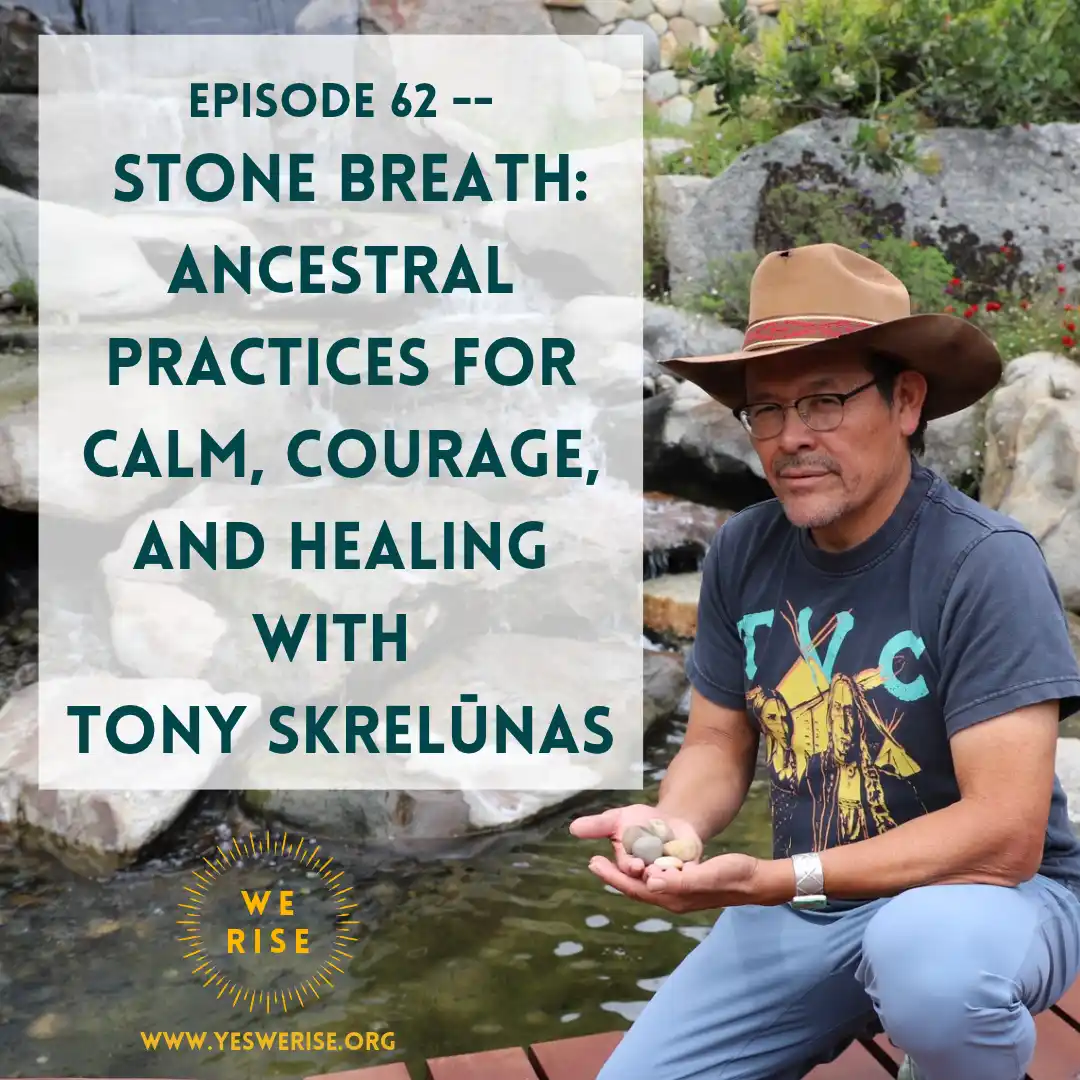
Episode 62 of the Yes! We Rise podcast
What if stress didn’t have to be the enemy? In this episode, Christine welcomes back her friend Tony Skrelūnas, Diné (or from the Navajo Nation), who was raised by his great-grandparents and still carries their teachings. Tony shares the story of his great-great-grandfather Sorefoot, a celebrated runner of the late 1800s, and the breathing and mind-training practices that let runners and knowledge-carriers cross deserts, plains, and mountains without panic. He walks us through the simple “stone breath” practice, explains why we can’t learn or lead well when our nervous systems are in fight-or-flight, and offers grounded ways to choose abundance over ego and negativity: morning prayer, gratitude, ritual around food, stepping back from negative news, and even finding the humor when the well runs dry. It’s a wise, warm, and deeply practical conversation about having a relationship with stress, remembering that none of our stories are ours alone, and living out the simple teaching to uplift your neighbor. Tony is the author of books that turn ancestral wisdom into stories for today, including Stone Breath (the first book of The Ancestral Watch series), Council Fire, and Far Messengers. Welcome to the Yes! We Rise Podcast!
Key Takeaways for Change-Makers:
- Build a relationship with stress. With the right tools and practices, stress doesn’t have to cause panic. It can become something you understand, work with, and grow through.
- Get in the proper state before you learn or lead. When your nervous system is wrecked, it’s “not a good energy exchange” or knowledge exchange. Calming the mind came first in every traditional training cycle Tony studied.
- Try the stone breath. Envision a pebble on your tongue, then relax your tongue, mouth, shoulders, and temples. Breathe in for about four, hold, breathe out longer (six to eight seconds), and hold for four.
- Your mindset is a choice. Notice when you’re operating from ego or your thoughts are turning negative, and pull yourself back toward gratitude and joy.
- Watch what you take in. Avoid gossip and negative news that mischaracterizes others; seek out sources of positive news and abundance instead.
- Make practices into rituals. Morning prayer, grounding with Father Sky and Mother Earth, gratitude (Navajos pray three times a day), meditation, and gratitude at meals all build a steady foundation.
- Don’t panic, and don’t tunnel vision. When the well is dry, that’s the most important time to stay calm, look at the whole landscape, and even find the humor. There’s always water somewhere.
- Learn from your ancestors and from others. Grasping one strong example from your own past helps, and none of our stories are only ours; we’ve always exchanged knowledge across peoples.
- It’s okay to crash and burn. Push yourself, enjoy it, and know you belong. There’s always another race.
- Uplift your neighbor. Share what you know so your family, neighbors, and community can thrive, and the blessing comes back to you.
find this episode on youtube
Chapters
- [01:19] Welcome back, Tony Skrelūnas
- [01:55] Yá’át’ééh abíní: growing up in Black Mesa and Big Mountain, raised by great-grandparents, and their teachings on caring for your thoughts and words
- [02:58] From transition economics to serving again as Navajo Nation head of commerce, and stepping down to be with his father
- [05:20] Intergenerational trauma and the Red Road Journey: healing our own healers
- [06:21] Focusing on sustainable development and intergenerational healing through writing, leadership development, and health care that includes traditional healing
- [07:42] Where to begin if you don’t feel a sense of lineage or community
- [08:22] Teaching non-Native students and a recent seminar with Hopi tribal managers and village administrations
- [08:49] A storyteller’s upbringing: creation stories, coyote stories, and a childhood TV appearance with his great-grandmother
- [09:59] Stone Breath and The Ancestral Watch series: writing characters to explore life’s challenges
- [11:00] Sorefoot, the runner: breath and mind training to calm the nervous system
- [12:21] Carrying oral knowledge across hundreds of miles and the training of “far messengers”
- [13:41] Teaching young people to think from abundance, not want or ego
- [14:59] Council Fire: the fourth world, and how we rebuild commerce, governance, education, and agriculture the right way
- [16:22] Far Messengers and reaching Hopi men through story
- [17:23] The discipline to pull back from ego and negativity toward gratitude and joy
- [18:08] “We’re all traumatized, but we have to deal with that”: acculturation, internal racism, and a grandfather who lived to 103 without speaking words of hurt
- [19:52] Mindset as a choice: what it looks like to notice and turn
- [20:38] Avoiding gossip and negative news; a search engine for positive news and Abundance Mindset Magazine
- [22:01] Lithuanian heritage, a love of Japan, and modernizing the discipline of sheep camp
- [23:11] Practices that ground us: morning prayer, Father Sky and Mother Earth, and gratitude three times a day
- [23:45] Food as healing: it’s how much and how you eat, and the power of ritual and gratitude at meals
- [25:14] The stone breath practice, step by step
- [26:58] Why being “in state” matters for learning, and how Pacific Islanders were taught to navigate by feeling the waves and reading the stars
- [29:31] Calming the mind first: Sorefoot’s races near Gallup in the late 1800s
- [30:54] Humor in hard places and the dry well: don’t panic, don’t tunnel vision
- [32:53] Christine reflects on fight, flight, freeze and being receptive to learning
- [33:15] A World Congress in Far Messengers and navigating climate change and the “hard desert” of life
- [34:58] None of our stories are just ours: clans, migration, and shared knowledge
- [36:16] Christine’s upcoming half marathon and Tony’s running life
- [38:58] Pushing yourself and having a relationship with stress
- [40:18] Visualizing calm, belonging, and the freedom to crash and burn
- [41:16] Running tips: lean at the ankles, relax the shoulders, balance the pebble, and don’t bounce
- [43:40] Doing more than ever without stress, and the teaching to uplift your neighbor
- [44:47] Closing reflections
Notable Quotes
“When you have those practices, what you can do is have a relationship with the stress…Stress is actually good if you… have the tools to encounter that.”
“Take care of yourself, take care of your thoughts… take care of what you say.”
“If you’re in a negative state, if you’re stressed, if your nervous system’s wrecked, and you’re trying to learn something… it’s not a good energy exchange, it’s not a good knowledge exchange.”
“Being in the desert was the most important time not to panic… because there’s always going to be water somewhere.”
“I think we can look to our ancestors… And every one of us has that in us.”
“None of our stories are all just ours.”
“If I sat back with all this experience and knowledge and… if I didn’t share it, then I’m not following the teachings of my great grandparents, which is you’re supposed to uplift your neighbor.”
About Our Guests
Tony Skrelūnas
Tony Skrelūnas is Diné (Navajo) and Lithuanian. He was raised by his great-grandparents in a hogan on Black Mesa with no electricity, so his TV, as he puts it, was books and his imagination, and by that kerosene lamp he studied Japan and Switzerland and imagined their worlds. In college he met an identity crisis and an inferiority crisis at the same time, came through both on one discovery, that he could be who he was, and finished at the top of his class elected as commencement Standard Bearer at Northern Arizona University’s College of Business, which later inducted him into its Hall of Fame.
For more than thirty years he has worked in governance, economic development and nonprofit leadership. He co-authored a law that returned traditional governance to more than a hundred communities, led the Grand Canyon Trust’s Native America Program for fourteen years, and speaks nationally on a just transition for communities moving off coal. Today he is a PhD candidate and Trustee at Prescott College, where his research centers on human performance and intergenerational healing.
His teaching is about resilience, and it starts with the body. The Stone Breath, a practice carried in his family from a long-distance runner who raced with a small stone in his mouth, comes down to one line: settle yourself first, then do the work. Under it sits his great-grandmother’s instruction, speak only what you want built, which he teaches as an abundance mindset rather than positive thinking. He is the author of Stone Breath, the first book of The Ancestral Watch series, and the founder of TribeAwaken.com, home of the free Abundance Mindset Magazine.
He writes to help you remember who you are.
About the Podcast
The Yes! We Rise podcast is produced by Dialogue + Design Associates, with music by Drishti Beats.
Follow the We Rise podcast on Facebook and Instagram.
Please rate, review, and subscribe to the podcast so we can continue spreading our message far and wide. Find our email list at the website: www.yeswerise.org. Thanks for listening.
Now more than ever, our world needs brave, visionary leaders to create positive change on a global scale. We need individuals and community organizers to rise up and build a future that allows our granddaughters and grandsons to thrive.
But where do these leaders come from? What inspires and motivates their impact? And how can the rest of us begin? How do everyday people take practical steps to “create the change they want to see in the world”?
At Yes! We Rise, we have solutions.
After 20 years helping individuals and leaders build a brighter future together, we know for a fact that real change happens based on the local ideas of local leaders.
You already have the power to make a meaningful impact. We’ll get you inspired and show you how.
At Yes! We Rise, we’re on a mission to help community leaders and members learn to forge a new path toward creating resilience and true transformation. One person at a time, one community at a time, one region at a time, the quilt of transformation can grow piece by piece until resilience becomes the norm instead of the exception.
To create change, people like you and me need to feel like we belong and that we are part of a growing movement. You need to know that your voice matters. That you have the agency and ability to transform your life and community. That you are the key to a resilient future.
If you’ve ever wanted to make a bigger difference inside your own community, or you’ve struggled to imagine what it would look like for you to create a more sustainable life and world, the Yes! We Rise podcast is for you.
From the Navajo Nation to the mountains of Appalachia, incredible work is already being done to create a more sustainable future. Community members are no longer waiting for someone else to come and save them. They realize they are the ones they have been waiting for.
On the Yes! We Rise podcast, we share the stories, strategies and tools of these ordinary people making an extraordinary impact.
When you hear and see what others have done to create real, true and lasting change (especially people in similar situations and places to you), you will begin to imagine what’s truly possible for you.
When you listen and learn from their stories and strategies, you’ll feel the spark they do and find new ways to create the change you want to see.
We’re here to help you get fired up to kick some ass, take inspired action, and dream even bigger—for yourself, your community
Links/Resources Mentioned:
Ancestral Watch — Tony’s website, home of Stone Breath and The Ancestral Watch series
TribeAwaken — home of Tony’s free Abundance Mindset Magazine
Yes! We Rise Episode 2 with Tony Skrelūnas — Tony’s first conversation with Christine
Books and projects by Tony mentioned in the episode: Stone Breath, Council Fire, Far Messengers, Abundance Mindset Magazine, and the Red Road Journey.
Learn more about Yes We Rise: yeswerise.org
Join Christine’s community work at Dialogue + Design: dialogueanddesign.com
Follow on social @yeswerise
The Yes! We Rise podcast is produced by Dialogue + Design Associates, Worthfull Media, music by Drishti Beats.
Follow Yes! We Rise on Facebook and Instagram.
Please rate, review, and subscribe to the podcast so we can continue spreading our message far and wide. Find our email list at the website: yeswerise.org. Thanks for listening.
Transcript
Stone Breath: Ancestral Practices for Calm, Courage, and Healing with Tony Skrelūnas and Christine Gyovai
Episode 62 of the Yes! We Rise podcast
Transcript
Episode 62: Stone Breath: Ancestral Practices for Calm, Courage, and Healing with Tony Skrelūnas and Christine Gyovai https://youtu.be/o6mP75RVUh0
Tony (00:00)
We gave them all these tools that brought in all these coaches, energy, meditation, leadership.
Positivity, teamwork, abundance. But
Christine Gyovai (00:08)
Mm.
Tony (00:09)
when you have those practices, what you can do is have a relationship with the stress.
Christine Gyovai (00:16)
Mm-hmm. Yeah.
Tony (00:17)
Know understand stress. Right now, most people, if you’re not having tools, you’re afraid of stress. It
Christine Gyovai (00:23)
Mm-hmm.
Tony (00:24)
causes you to you know get the knots, it causes
Christine Gyovai (00:27)
Yeah.
Tony (00:27)
you to get panic attacks, it causes your heart rate to go up.
Christine Gyovai (00:31)
Mm-hmm.
Tony (00:31)
Stress
is actually good if you
Christine Gyovai (00:34)
Mm.
Tony (00:34)
know if you have the tools to encounter that
Christine Gyovai (01:19)
Tony Skrelunas thanks so much for joining the We Rise podcast. I’m so glad to have you back on the
show. We had a conversation a couple of years ago, and I still think about a lot of the things that you said in that conversation about greeting the morning, about your
Tony (01:35)
Yes.
Christine Gyovai (01:35)
ancestors, about your lineage and connection to place. And it was such a rich conversation. And I’m really so glad to be able to talk with you again. You have so much wisdom.
For folks who
Tony (01:45)
Thank you.
Christine Gyovai (01:45)
might not have seen that show or listened to it, tell us a little bit about how you engage in community and a little bit about yourself.
Tony (01:55)
Sure. good morning, Christine. um Yá’át’ééh abíní that’s my my traditional greeting, you know. Um that all is all is in harmonious and beautiful. Um, I come from a place called Black Mesa, uh Big Mountain. And I was raised by my great grandparents, you know, and a lot of their teachings and
their guidance in early in my life really have um framed what I do. that’s really you know, one of the things that they would always
infuse in in in conversation is the need to, you know, like you talked about, be up early, take care of your home, take care of yourself, take care of your thoughts, you know, uh take care of what you say. be you know, speak words of um goodness and and and learn to be um learn teachings, learn learn a way to
to have knowledge and to pass it on, you know.
Christine Gyovai (02:57)
Mm.
Tony (02:58)
So um that’s really encompasses uh a lot of my work these days, you know. I was um I think the last time we spoke I was most of my emphasis was on transition economics, you know, working at small scale and um helping
Christine Gyovai (03:12)
Mm-hmm, yeah. Yeah.
Tony (03:16)
in like
villages and small like culture based businesses get started. and I did some planning with like uh I know we did some work with one of the Hopi villages, you know. but since then I served a stint I served
Christine Gyovai (03:32)
Mm-hmm.
Tony (03:33)
a stint in the Navajo Nation as um
It’s just something I did over twenty twenty years ago, which was I was head of commerce and
Christine Gyovai (03:41)
Mm-hmm.
Tony (03:42)
so I served that role again um for the nation for about three years. I think that’s the last time I did the podcast.
Christine Gyovai (03:47)
Mm-hmm. Yeah, yeah.
Tony (03:50)
And um just finished up about a year ago, you know, and I really have at that point you know, you go through life transitions and
mine was my father passing
Christine Gyovai (04:02)
Mm.
Tony (04:02)
You know,
um and that’s really one of the reasons I after three years I stepped down because I wanted to spend
Christine Gyovai (04:07)
Mm.
Tony (04:08)
at least the last m month, month, two months with him and to be uh part of that that transition is was really important for me, you know, just just to because of the way I was raised. And also I uh
I had started like a PhD program tw twenty five years ago, plus plus I had started a PhD program in
Christine Gyovai (04:25)
Mm. Mm-hmm. Uhhuh. Oh wow. Yeah.
Tony (04:31)
in economics and I think about two years ago I was a a commencement speaker at a college in Prescott,
Christine Gyovai (04:37)
Mm, mm,
Tony (04:38)
I went there early and um
interacted with a lot of the students, a lot of the professors.
Christine Gyovai (04:44)
Yeah.
Tony (04:45)
I listened to uh quite a bit of the um dissertation, you know, presentations
Christine Gyovai (04:52)
Mm.
Tony (04:53)
and um I fell in love with um the idea of finishing that. That’s what I had started a long time ago, you know,
Christine Gyovai (04:59)
Mm, mm.
Tony (05:01)
’cause I was getting an MBA and I I had uh added uh some work around a PhD program and so I applied
Christine Gyovai (05:09)
There’s no
Tony (05:09)
and
got accepted and so I was like, Well, you know, this is kind of the creator talking to me and um
Christine Gyovai (05:19)
Mm.
Tony (05:20)
and it was really thing the the thing too that um I’ve seen a lot of intergenerational trauma cu you know that manifests itself, you know.
Christine Gyovai (05:27)
Yeah. Mm-hmm.
Tony (05:30)
And I see that in not only in my family, you know, we
You know, our our people have gone through like the Long Walk and periods of acculturation and uh just a lot of even our government has been designed to not not really embody the culture, not really embody the values of the people, you know? And
but in in in a macro level I see that you with other nations all over, not just tribal, you know. And so
Christine Gyovai (06:00)
Mm-hmm. Yeah. m
Tony (06:02)
I had started a group of elders coming together, a group of cultural leaders, some time ago. I called the Red Road Journey. Uh it’s
Christine Gyovai (06:06)
Mm, mm, mm.
Tony (06:11)
about maybe four years ago I started ah
Christine Gyovai (06:14)
Mm.
Tony (06:16)
just with the idea of healing our own healers, you know? And uh
Christine Gyovai (06:19)
Mm, mm, mm.
Tony (06:21)
and so when I applied back to the PhD program, I wanted to, you know, continue to focus on sustainable development, but really lean into intergenerational healing as as really my focus area. So that’s what I’ve been doing, Christine, is um I’m doing a doing a lot of work around that, you
Christine Gyovai (06:38)
Amazing Tony. Yeah.
Tony (06:41)
know, doing a lot of work around
I’m writing a bunch. this is really had has allowed me to reignite the discipline of writing and uh
Christine Gyovai (06:50)
Mm.
Tony (06:51)
and then leading, you know, I’m leading uh major sessions, leadership development sessions,
Christine Gyovai (06:56)
Mm.
Tony (06:57)
um guiding health health development because that’s really the feel, you know.
Christine Gyovai (07:00)
Mm-hmm.
Tony (07:02)
I’m really in in leading some um strong health care development that encompasses
wellness and um kind of the tr traditional healing. So
Christine Gyovai (07:15)
Mm-hmm. Mm. Beautiful.
Tony (07:17)
Yeah.
Christine Gyovai (07:18)
You have woven such a beautiful web and picture of different things. I want to go back to one of the early strands, Tony, that you talked about learning and teaching and lineage. You talked about listening to creator and knowing when to lean back into your PhD program
Tony (07:36)
Yeah.
Christine Gyovai (07:36)
in order to offer what you’re offering, including healing your own healers. For people
Tony (07:41)
Yeah.
Christine Gyovai (07:42)
who might not have a strong sense of community.
or connection, but they’re trying to seek change in their community. They’re trying to know how to listen. They’re trying to know you talked about choosing your words, having right speech to some degree. Where can people start if they don’t feel a sense of lineage or if they don’t feel a sense
Tony (08:04)
Mm.
Christine Gyovai (08:05)
of community about where to lean in and where to listen? That’s a complicated question.
Tony (08:09)
Sure, sure, sure.
Well, I I sense that and uh Christine I I’m actually like adjunct faculty at um institute up in Santa Cruz up in the mountains there.
Christine Gyovai (08:20)
Mm-hmm. Mm-hmm.
Tony (08:22)
And a lot of my um students are non native, you know? So um
Christine Gyovai (08:27)
Mm-hmm. Yeah.
Tony (08:28)
and I do seminars like down in um
Different places, Mexico, Northern Arizona. Uh I just did one with Hopi. We just did a big seminar last week with the Hopi, all their
Christine Gyovai (08:38)
Mm, mm, mhm, mhm.
Tony (08:43)
their tribal um managers and village uh administrations, you know.
Christine Gyovai (08:48)
Mm-hmm, mm.
Tony (08:49)
I was researching like how do I teach
intergenerational healing. How is it that ’cause you in our way we’re storytellers, right? So as a as a Native American as
Christine Gyovai (08:59)
Mm-hmm.
Tony (09:02)
an Navajo and especially me being raised by my great grandparents, I was taught a lot of stories about like um creation and uh you know the warrior twins and
Christine Gyovai (09:13)
Mm.
Tony (09:14)
um the relationship between um Mother Earth and Father Sky and um
the deities and and a lot that’s passed down in story and then you learn like coyote stories and and I would always recite coyote stories when I was a kid, you know, ’cause I just loved it, you know.
Christine Gyovai (09:30)
Hmm. Mm-hmm.
Tony (09:32)
They actually put me on a a little TV show out of Phoenix with my great grandmother.
Christine Gyovai (09:35)
Mm, mm, mm, mm.
kid.
Tony (09:39)
we
had to tell stories in a way that people could um grasp the basic concept, and then you did you let the people kind of figure it out, you know. And so what I did is I created um that’s why my I started writing. I w I wrote this book, it’s kind of it’s released all over the world now.
Christine Gyovai (09:59)
Great. Okay. We’ll link to that, Stone Breath.
Tony (10:00)
It’s called Stone Breath, you know. Stone Breath is a
yeah, is um it I have it on my website. It’s called Ancestral
Christine Gyovai (10:08)
Okay.
Tony (10:09)
Watch. Ancestralwatch dot com. Um and
Christine Gyovai (10:12)
Great, we’ll include that link.
Tony (10:13)
it’ll link you to, you know, the the story that I created was characters, you know.
I created characters and um yeah, you know, of course my my childhood kind of inspired this writing
Christine Gyovai (10:27)
Sure.
Tony (10:27)
because I was I’ve been pulling together a lot of writing. As you know, I run an online journal, you know, and I’ve
Christine Gyovai (10:34)
Mm-hmm.
Tony (10:35)
I’ve done I do an online magazine too where I write a lot because I have
Christine Gyovai (10:37)
Mm-hmm. Yeah.
Tony (10:39)
kind of a a pretty small lead readership, you know.
Christine Gyovai (10:42)
Yeah.
Tony (10:42)
But
uh sometimes these articles resonate with a lot of people and I see it get shared uh
Christine Gyovai (10:47)
Mm-hmm. Mm-hmm.
Tony (10:49)
quite a bit. but what I did is I created characters and I started writing about um different challenges in life, you know, and how you overcome them.
Christine Gyovai (10:58)
Mm-hmm.
Tony (11:00)
and Stone Breath is based on um my my great grandmother’s father, um his name was Sorefoot, you know.
Christine Gyovai (11:08)
Mm, mm.
Tony (11:08)
And he was a runner. He was a
really well-known runner that um would go and do these intertribal races, you know. This is like in the 1800s. And
Christine Gyovai (11:19)
Well.
Tony (11:19)
but he would run and and train like the mind and the um the the breathing techniques, you know, and they
Christine Gyovai (11:27)
Mm.
Tony (11:27)
they they actually practiced
mindfulness and breathing technique to calm their nervous systems and to minimize moisture loss from breathing and lower their heart rates, ground themselves, you know, to really have strong minds so they they they could encounter pretty much anything and not get alarmed,
Christine Gyovai (11:49)
Hmm.
Tony (11:51)
and
And so she would always tell me that story. And um, and then my great grandfather, you know, and and he would always tell me these stories of just a lot of the travel to create teachings and stories a long time ago, and what like a leader really was. There wasn’t really a leader, it was a different kind of definition. And but they would always talk about well.
y when you created responsibility to pass knowledge and you want
Christine Gyovai (12:20)
Mm.
Tony (12:21)
to have somebody go and travel to whatever medicine, drought, agriculture, people lived far apart. I mean
you’re talking sometimes hundreds of miles and and it was all oral too, you had to remember. So
Christine Gyovai (12:36)
Hm, mm-hmm.
Tony (12:38)
to remember you had to be in state to be able to capture and then to retell and then
Christine Gyovai (12:45)
Mm.
Tony (12:46)
you had to cat create the story in a way that’s rememberable memorable you know and
Christine Gyovai (12:50)
Mm, mm-hmm, mm-hmm.
Tony (12:53)
um and so then they use like songs they use all these like stories and I started studying that that exact piece of it is like well
Christine Gyovai (13:02)
Mm.
Tony (13:02)
what’s what’s the
How did this work in other places in the world, you know? and then the the the thing I discovered was there was a training cycle for that role, you know. And so I came up with the the definition, I call it far messengers, that
Christine Gyovai (13:19)
Mm-hmm.
Tony (13:19)
every society in the world had um far messengers at one time and they’re past, you know.
Christine Gyovai (13:23)
Mm-hmm.
Tony (13:26)
And um it’s really
understanding you sometimes you grasp it more if you study like other cultures, you know, like
Christine Gyovai (13:33)
Mm-hmm.
Tony (13:34)
the Pacific Islanders, you know, the the folks in the Saudi Arabian desert, uh
Christine Gyovai (13:39)
Mm.
Tony (13:41)
people that live in that cross mountains that um that used to find islands, you know, like in the Pacific. Um that they they created these
young people to to control their their their minds, their thoughts and to even the way they th taught thinking was more of like a almost like abundance only. You know, you’re
Christine Gyovai (14:05)
Mm.
Tony (14:05)
you’re like you’re you’re not in want, you’re not in hunger, you’re not in um you’re not trying to be impressive, you’re not operating from a place of ego
‘Cause you had to really, really be in state to to feel like the waves of the water, to remember what the songs mean and the teachings mean. So where you know where the springs are, where certain
Christine Gyovai (14:29)
Mm-hmm.
Tony (14:30)
foods grow and certain plants are, which birds are flying, which direction. and um so that that’s where um really I I I think
we we if you can grasp like one strong example of your were your past you know I think it’ll really help you understand it’s helped me in my life immensely. I mean I’ve written several books now
and the the next one I wrote was called Council Fire and
Christine Gyovai (14:59)
Mm, mm.
Tony (15:01)
it’s really it’s more of like these
We’re we’re in the fourth world, we’re kinda in the fourth quarter, the last thirty seconds. You know, there’s reasons that
Christine Gyovai (15:09)
Mm-hmm. Yeah.
Tony (15:11)
we’re in the fourth world ’cause we didn’t do a good job in the third world or the second world or the first world.
Christine Gyovai (15:13)
Yeah. Mm-hmm. Mm-hmm.
Tony (15:16)
and what happens if we have to go to the fifth world, you know?
Christine Gyovai (15:20)
Mm.
Tony (15:21)
And what h what do we how do we ensure that um
There’s stories and there’s story of what went wrong and what not to do. And so
Christine Gyovai (15:29)
Mm-hmm.
Tony (15:30)
and then how do we how do we rebuild society in the future, you know? I mean and and how do we heal? Because most most of us are most most peoples are have intergenerational trauma, you know, they’re living in fight or flight,
Christine Gyovai (15:43)
Mm-hmm. Yeah.
Tony (15:45)
um paycheck to paycheck. Um you just have all this
layers and layers and how do you how do you clear that out of your your future, you know, how do you clear out of your future children, your grandchildren and
Christine Gyovai (16:00)
Yeah.
Tony (16:01)
and make make them far messengers, you know, how do you
Christine Gyovai (16:04)
Hmm.
Tony (16:04)
do that? And so that’s really the the writing of um Council Fires and say down the road
Christine Gyovai (16:09)
Mm-hmm.
Tony (16:10)
you rebuild, you know, commerce the right way. You rebuild governance
Christine Gyovai (16:13)
Mm-hmm.
Tony (16:14)
and education and
agriculture you and you you really learn from the mistake of the fourth World. And
Christine Gyovai (16:21)
Mm-hmm.
Tony (16:22)
so that’s that book. And then I wrote a book called Far Messengers, which is just really just leaning into this subject, massive, you
Christine Gyovai (16:27)
Mm. uh
Tony (16:31)
know. And so that’s really I think the way I’ve been able to reach a lot of people is that I I
then can tell stories around this subject.
because I’ve become an expert in this um this feel of how do you get people in the proper state, why is it so important? Uh and Hopi it resonated. It really, I mean, especially
Christine Gyovai (16:53)
Mm. Mm-hmm.
Tony (16:55)
in one of the places that a lot of us the folks like they um that are maybe doing wellness, they have a hard time reaching is the men. I was able to reach a lot of the Hopi men, you know, I
Christine Gyovai (17:04)
Mm, mm-hmm, mhm, mhm.
Tony (17:07)
and so
It’s it’s really a way to get people to understand and for me it’s it taught it I know then like if I understand like a you kind of have almost like a a manual, right? And
Christine Gyovai (17:23)
Mm-hmm.
Tony (17:23)
you can you understand when your thoughts are going a certain way that you but you now have the discipline to always
Christine Gyovai (17:30)
Mm,
Tony (17:30)
pull up back.
Christine Gyovai (17:31)
mm.
Tony (17:31)
You know, you always
like let’s say some days I I maybe I might be operating from a place of ego or maybe I feel like I might have a thought that that goes negative in some setting, right? But then
Christine Gyovai (17:46)
Mm-hmm.
Tony (17:46)
I always pull it back and say I’m not wanting to I’m not here to impress anybody. I’m not here to be myself to enjoy it. There’s a lot of there’s a lot of beautiful joy here, you know.
you know, I’m really fortunate and then you then look at your your the your discipline of gratitude. I mean there’s all these like all the teachings that I was taught as a kid, you start
Christine Gyovai (18:07)
Mm-hmm, mm-hmm.
Tony (18:08)
infusing it
I’ve been able to infuse it into my my life. And because we all have trauma, you know. I mean I I had growing up with great grandparents, you know, my my my parents went through like things like alcoholism, you had all the the schools and the acculturation.
And then you had like kind of internal racism too. Our own people kind of being racist ’cause we’re some of us are real um real rezzy. So I was I was one of the real rezzy boys, you know.
Christine Gyovai (18:38)
Mm, mhm, mm. oh
Tony (18:41)
So I had to go off res to school
Christine Gyovai (18:43)
Hm.
Tony (18:44)
and so those kinds of things impact you later on, you know, things like that. And so you learn how to that’s what I mean, we’re all traumatized, but we have to deal with that.
And, you you really have to watch, you know, and and l my grandpa, he lived to be hundred and three, but he was really he never let that get to him. All that stuff it was always um he always had positivity, he always had um he never uh spoke words of like hurt, you know,
Christine Gyovai (19:13)
Mm.
Tony (19:14)
and and so I try to follow that and I I I made him one of the characters in the in my books, So
Christine Gyovai (19:17)
Mm-hmm. Mm-hmm. Mm-hmm. Yeah, love that.
Tony (19:21)
Yeah.
Christine Gyovai (19:22)
So a couple really key things. I mean, obviously it’s a a lifetime of learning and
Tony (19:28)
Yeah.
Christine Gyovai (19:28)
teaching and storytelling and place, but some of the things I heard you talk about were teaching a mindset, teaching
Tony (19:35)
Yeah.
Christine Gyovai (19:36)
a a mindset and a heart space, perhaps of abundance, paying attention and having awareness where you might be coming from ego, or if your thoughts might be turning more negative.
Um, cultivating gratitude. You talked about beautiful
Tony (19:52)
Yeah.
Christine Gyovai (19:52)
joy. What does that look like for you to break it down even a little bit further? Because I don’t think many people have that awareness that that’s even a choice. That the mindset that we go into each day is a choice that we have. And so if people are are struggling on a day, can you break down a little bit more, Tony, what that looks like to notice, hey, I’m coming from a place of ego today? Or hey,
My thoughts are starting to take a negative turn. What does it that turn look like for you to come from a place of abundance or to make a different choice?
Tony (20:26)
Well
well obviously it’s um I’m very self aware because this is my writing, you know, and um and I teach a lot of tools, right? I teach a lot of examples and and you
Christine Gyovai (20:32)
Mm-hmm. Mm-hmm. You have a practice. Mm-hmm. Mm-hmm.
Tony (20:38)
know, you of of of things like let’s say like envy, you know, or
Christine Gyovai (20:42)
Mm-hmm.
Tony (20:43)
um uh we’re taught to not create gossip, you know. We’re
Christine Gyovai (20:48)
Mm-hmm.
Tony (20:48)
taught to not talk about other people. So
a good example is like if you read just negative news, if you look at like a lot of the the the stuff that’s out there is really
Christine Gyovai (20:59)
Mm-hmm.
Tony (20:59)
bashing other people and mischaracterizing and um so if you look at that kind of news and then your your brain is going there, you know.
And if you listen, if you’re around people that are uh talking like that, that influences you, you know. So if if if you know, that’s where like they tell you like it’s really important to not be on your phone, to
Christine Gyovai (21:24)
Mm-hmm. Mm-hmm.
Tony (21:25)
and so we don’t we don’t watch news much, you know, my family and I, um
Christine Gyovai (21:28)
Mm-hmm, mm-hmm.
Tony (21:30)
I used to read the paper all the time, but now it’s rare, you know.
Christine Gyovai (21:31)
Yeah, yeah.
Tony (21:33)
And I created my own search engine for positive news, you know. So people can
Christine Gyovai (21:35)
Mm. I love that.
Tony (21:37)
people can subscribe to that on my website. Yeah, it’s all posit it’s it’s it’s really um abundance. I
Christine Gyovai (21:39)
I love that. That’s great. That’s all great.
Tony (21:43)
created a thing called Abundance Magazine and
Christine Gyovai (21:45)
That’s great.
I love that.
Tony (21:48)
It’s have a pretty good leader readership. Seventy people like yeah,
Christine Gyovai (21:50)
Yeah. That’s great. I love that. That’s great.
Tony (21:53)
I it has a search engine and it finds all I and I write like um different languages so uh
Christine Gyovai (21:59)
Mm-hmm.
Tony (22:01)
You know, a lot of I’m leaning well. I’m also half Lithuanian. So a lot of my my characters
Christine Gyovai (22:03)
Mm, interesting. Huh.
Tony (22:06)
and my research is on Lithuania
Christine Gyovai (22:08)
Mm-hmm.
Tony (22:09)
and um when I was a kid growing up in the Hogan, I used to always order books from Japan, karate. Just I got into koi fish, I got into um Japanese architecture. It still infused the gardening
Christine Gyovai (22:14)
Interesting. Huh huh interesting. Huh. Yeah. Yeah.
Tony (22:21)
I built like a koi fish garden, I built um
Japanese bridges, I mean just, the the Torii waterfalls, things like that. And um
Christine Gyovai (22:30)
Mm, yeah.
Tony (22:32)
I find a lot of ever since I was a kid, I found a lot of similarities on on maybe how being an Navajo in a sheep camp and discipline
an example of of let’s say like a more of a modern
Say you took that and you said that we’re gonna modernize that in a really proper way. You know, you know, not not build a big city and make it New York City,
Christine Gyovai (22:51)
Mm-hmm. Yeah.
Tony (22:54)
but how did you how could you take that experience? I just felt like the the closest tie was Japan,
Christine Gyovai (23:02)
Yeah, fascinating.
Tony (23:03)
Samurai and just
just like how if you could take my great grandmother or grandfather’s life and somehow modernize it. That’s what
Christine Gyovai (23:10)
Mm-hmm.
Tony (23:11)
you would get in a in a you know, you keep the disciplines, you keep all the the practices. So I think it’s the practices, it’s
it’s the morning prayer. Starting
Christine Gyovai (23:22)
Mm.
Tony (23:22)
out your morning you know, and it’s how you do your prayer, you know, you
Ground yourself, you know, Father
Christine Gyovai (23:28)
Mm-hmm.
Tony (23:28)
Sky, Mother Earth, all the elements. You feel the the nature and the good things around around you and then you your gratitude is really important. and every day, you know, and us in Navajos we pray three times a day. So um and
Christine Gyovai (23:43)
Mm, mm-hmm.
Tony (23:45)
and you and then and and making it a ritual. And I was reading
an article, I do a lot of research around food and and food is healing has been a big part of my work is educating
Christine Gyovai (23:53)
Mm, mhm, mhm.
Tony (23:56)
and really studying things like the Mediterranean diet and the plant-based
Christine Gyovai (24:01)
Mm-hmm.
Tony (24:02)
uh foods and I I respect all that it’s really important but
Christine Gyovai (24:04)
Mm-hmm. Mm-hmm.
Tony (24:06)
uh the the the real thing is that if you it’s not it’s not what you eat it’s how much you eat and how you eat it that really
Christine Gyovai (24:14)
Mm,
mm-hmm, mm-hmm, mm hmm. Yeah.
Tony (24:15)
or health is more more the the latest research and if you can add ritual to your food
if you add in doing even a a a proper gratitude expression and i know like the hopies you know because my kids are half hopi they take a piece
Christine Gyovai (24:31)
Mm-hmm.
Tony (24:31)
of their food and they’re feeding the the the kachinas you know they set it aside
Christine Gyovai (24:35)
Mm.
Tony (24:36)
and I really respect that and I sit there and I wait for them to do that you know
Christine Gyovai (24:40)
Mm-hmm,
mm-hmm.
Tony (24:41)
And
these and then that that sitting together in the ritualistic way of of a process is what it that creates like a real almost like the good stuff about the food, you know. It might be
Christine Gyovai (24:53)
Mm-hmm. Mm-hmm.
Tony (24:55)
it might have been a GMO or whatever, but there there’s good there, you know? And so
Christine Gyovai (24:57)
Right. Right.
Tony (24:59)
that more of the research is finding that.
so if you can be disciplined and following this and and things like meditation, you know, five t twenty minutes and I’ve incorporated that for a long time,
Christine Gyovai (25:13)
Mm,
Tony (25:14)
almost daily and then breathing, you know, um the stone breath, you know. It’s really that at
Christine Gyovai (25:16)
Mm-hmm. Mm. Tell us more about that stone breath.
Tony (25:21)
at the basic thing, uh and and you know, a long time ago what they did is they actually um and I
way I teach it is that you envision you envision a picking up a pebble, you
Christine Gyovai (25:32)
Mm.
Tony (25:33)
you’re you’re you’re grounding yourself with that pebble and then you’re um what a long time ago our runners used to do is put it on their their tongue, you know.
Christine Gyovai (25:42)
Mm.
Tony (25:43)
Um, but we we don’t do that, you know, because they were disciplined, they they just that’s what they were taught. Now you don’t do that. I tell people don’t do that. But you can vision it, you can envision it on your tongue and
Christine Gyovai (25:45)
Mm-hmm. Mm-hmm. Right, right, right. Interesting. Huh.
Tony (25:57)
But then what your job is is to relax it, to relax your tongue, to relax your mouth and your muscles and to balance it, you know, to calm down your shoulders and you start your temples and your breathing and your um you’re not overthinking like should I breathe through the nose, should I breathe through the mouth, you know?
Christine Gyovai (26:16)
Mm-hmm. Mm-hmm.
Tony (26:18)
And um and what I taught around that then is like a box a set of box breathing, you know.
Christine Gyovai (26:25)
Mm-hmm,
Tony (26:25)
So it’s really the four in, you know, four in
Christine Gyovai (26:25)
mm-hmm, mm-hmm.
Tony (26:28)
but not worrying about where the breath in is, you know. But you’re relaxing that pebble on your you know on your
Christine Gyovai (26:31)
Okay. Mm, mm-hmm.
Tony (26:35)
in your mouth and you’re holding it for but then the out breath is where, you know, relax. The longer out breath the better, you know.
Christine Gyovai (26:42)
Mm. Mm-hmm.
Tony (26:45)
Relax and so uh six, eight seconds and then
hold for four, that’s really the the basic uh first step of the the stone breath, you know.
Christine Gyovai (26:57)
Beautiful.
Tony (26:58)
And why that’s important, Christine, is um let’s say we were gonna go deeper and I was gonna tell stories, right? That I wanted you to remember. I wanted you to learn these I’d want you to be in the proper state. You know, it’s like
Christine Gyovai (27:11)
Hmm.
Tony (27:12)
if you going into um
if you’re in a negative state, if you’re stressed, if your nervous system’s wrecked, and you’re trying to learn something, it that that’s not it’s not a good energy exchange, it’s not a good knowledge exchange, If you’re in a proper state, you know, and that’s why it was so important is that we a good example is like um you know how they taught kids in the Pacific how to navigate the oceans.
Christine Gyovai (27:39)
Hm, mm.
Tony (27:40)
two thousand miles, you know,
and and then they they could actually find the islands, you know,
Christine Gyovai (27:46)
Mm.
Tony (27:47)
is that what they first did is they would just blindfold them and put them have them lay on their backs on the boat, you know. and they had to really lower their their heart rates and then they could feel the the rhythm of the waves, you know.
the the waves and how how the waves are otherwise if your like heart rate’s going all over the place if your nervous system’s going all over the place that’s that that kind of thing doesn’t happen and but that that just that example right so there’s a
a a gentleman that in the seventies, see a lot of the history books was well all those islands were just Fiji, Hawaii, all it was an accident. Somehow people drifted there. You got like ten million square miles. Somehow people drifted to the island. Oh, and then
Christine Gyovai (28:30)
Mm. Mm. Mm. They just happened to land there, right.
Tony (28:38)
this guy um they found a guy in the seventies that says, No, that’s not true. There’s a way that
Christine Gyovai (28:43)
Mm-hmm.
Tony (28:43)
you there’s you know, and he did it. He goes, I’ll show you. So they built a two hulled boat.
canoe, two -hulled canoe and with
Christine Gyovai (28:48)
Yeah. Uh-huh.
Tony (28:50)
the group and and what he did is he would lay down and just re re teach this and he knew when they were off course I mean they looked at the stars too they
Christine Gyovai (28:59)
Mm-hmm. Hmm.
Tony (29:01)
were taught like the sky is what they’re they were the way they taught it is like there’s thirty two houses, you know there’s
Christine Gyovai (29:08)
Hm.
Tony (29:09)
two the thirty two houses in the sky and then you can really even since there’s star sets in every one of them.
And
Christine Gyovai (29:16)
Mm-hmm.
Tony (29:16)
if you always will know which if you can learn all that, you always know where you’re at, you know? And
Christine Gyovai (29:22)
Mm-hmm. Love that.
Tony (29:23)
and that’s just two examples, but they were taught like five or seven tools that they had to learn. And
Christine Gyovai (29:31)
Mm-hmm.
Tony (29:31)
the but the first thing it started was calming the mind and calming yourself so you can be in state, you know. And that that’s why breathing was so important.
The same with like runners. Like imagine my great grandfather’s time when he um what the story was was when they had first had like the races in um around Gallup years ago. It’s like late eighteen
Christine Gyovai (29:53)
Mm-hmm. oh
Tony (29:55)
hundreds, you know. He would he would win a lot of them, but
Christine Gyovai (29:58)
Mm.
Tony (29:59)
it but that would that’s when the trains were coming in and people were
You got Plains Indians, you know, because it was a big deal, right? Just when they had the Wild West shows and they would bring in
Christine Gyovai (30:07)
Mm-hmm, mm-hmm, mm-hmm.
Tony (30:11)
um like these runners from other tribes and the pueblos
Christine Gyovai (30:14)
Mm.
Tony (30:14)
and it was really imposing, right? You’re you could lose the battle, you could lose a race before you even started, just by seeing these other tribes. So it’s all
Christine Gyovai (30:17)
Hmm. Right. Right. Mm-hmm. Mm-hmm. Mindset again. Heart space. Yeah.
Tony (30:25)
heart, it’s all mind, and then it was there was ritual involved, right? Because this is really competitive. This it’s like almost like
A long time ago they used to fight, but now the they’re the the battles are more in the competition. So very spiritual. And
Christine Gyovai (30:40)
Mm.
Tony (30:40)
so this is why it was so important for him to so it was a lot of its breath, it was like deep meditation, sauna, diet, you know, and and just practice like a life.
Christine Gyovai (30:52)
Mm.
Mm.
Tony (30:54)
And you still had to have your family, you still have to have your kids, you still have to have your your partner in life and your animals and your agriculture, things like that. But you had to really discipline yourself and well around and that’s why we we teach things like like humor, right? You’re
Christine Gyovai (31:13)
Mm.
Tony (31:13)
you’re in the most difficult situation, but you look for the humor in it. So you come to
Christine Gyovai (31:18)
Mm, mm.
Tony (31:20)
a well that’s dry.
let’s say you’re traversing and the most most people would panic, you know,
Christine Gyovai (31:28)
Mm-hmm.
Tony (31:28)
but it was so important, that was the most important time not to panic.
Christine Gyovai (31:33)
Mm-hmm.
Tony (31:34)
And so because there’s always gonna be water somewhere, you know. Might be a couple miles, but yeah, you’re
Christine Gyovai (31:37)
Mm-hmm. But it’s Right. There’s always gonna be water somewhere. Yeah. Yeah.
Tony (31:43)
but most people if untrained, they would panic and
You know, when you panic, you’re not you’re you’re pretty much your your executive function, your breathing, your thought pattern, you get tunnel vision. So one of the things that my my my great grandmother used to say is like, when you look out, when you’re um you know, don’t don’t drink too much water too. Don’t don’t depend on water so much, Don’t
Because learn to discipline yourself. Learn to
Christine Gyovai (32:11)
Mm.
Tony (32:12)
lower your heart rate. So when you’re out herding sheep and stuff and it’s like don’t tunnel vision too, if you always look at
the the whole area, you know? And the research is again that calms you, you know, that
Christine Gyovai (32:27)
Mm.
Tony (32:28)
that kind of uh looking at, you know, because it first thing you do when you panic is you focus and you get tunnel vision, you know. So those those those there’s a and and again a lot of that is
Christine Gyovai (32:42)
Mm-hmm. I love that. So we’re gonna have to link back to your books
Tony (32:46)
Yeah.
Christine Gyovai (32:46)
and your website.
I wanted to really thank you for that, what you just offered.
Tony (32:52)
Yeah.
Christine Gyovai (32:53)
Such a core practice. When you’re in panic mode, your fight, flight, or freeze response is up,
Tony (32:59)
Mm.
Christine Gyovai (33:00)
your executive functioning’s offline,
Tony (33:02)
No.
Christine Gyovai (33:02)
and you’re also not receptive to learning. And
Just bringing that in, the box breathing you talked about, calming the nervous system and making yourself receptive to learning. We don’t we don’t practice that
Tony (33:15)
in and what what’s and why that’s so important is um
Far Messengers is a book I wrote about um it’s kinda like near the end and there’s a World Congress, you know, up in the mountains in Switzerland.
Christine Gyovai (33:25)
Mm, mm, mm, mm.
Tony (33:31)
and there’s peoples from all over the world, including uh Navajo that are navigating there and they’re selected because of how they’re living their lives and trying to to keep the knowledge going, you know.
But there’s also experts, right? Climate experts, the scientists, the government officials. But this is kind of the last ditch effort to ensure that um how do you navigate the worst of things like climate change, you know, how do
Christine Gyovai (34:00)
Mm-hmm.
Tony (34:00)
because we used to cross deserts, we used to cross oceans and mountains,
Christine Gyovai (34:05)
Mm-hmm.
Tony (34:06)
and these kinds of breathing patterns and thought patterns and disciplines allowed us to do that.
Christine Gyovai (34:12)
Mm-hmm.
Tony (34:13)
How
do we in the worst case, let’s say 200 years from now or 100 years from now, navigate those kinds of situations again? even now, right? We’re we’re on hard ground. You could go negative and like see the news, see what’s going on in the world, that’s not an abundance mentality,
and sometimes I think societies have to do that, but I think
Christine Gyovai (34:40)
Mm-hmm.
Tony (34:40)
there’s another way of of navigating life and even in the in the hard um know the hard desert, you know, if you will, the of life that
Christine Gyovai (34:50)
Mm-hmm.
Tony (34:51)
I think we can look to our ancestors and we can look to
And every one of us have that in us and just studying
Christine Gyovai (34:57)
Mm-hmm.
Tony (34:58)
it, you know. It’s studying that and um and learning from others too, because none of our stories are all just ours. You know, we we visited, we exchanged
Christine Gyovai (35:07)
Yeah. Mm. Yeah.
Tony (35:10)
knowledge between people. That was what made um life so special, you know, and we would take a little bit of this, a little bit of that. And
Christine Gyovai (35:15)
Yeah. Yeah. Beautiful. Yeah.
Tony (35:19)
Like Diné Navajo, Diné is the people, you know, it’s a place
Christine Gyovai (35:22)
Mm. Yeah.
Tony (35:23)
and I’m I I’m Tódíchʼíiʼnii in the Bitterwater, but
Christine Gyovai (35:26)
Mm-hmm.
Tony (35:27)
my uncle tells a story that we are related to the Sinagua people that were already here, you know,
Christine Gyovai (35:33)
Hmm, mm-hmm.
Tony (35:34)
and that there’s stories of how they migrated and we’re not you know, our clans we have like eighty clans and we have like Mexican clans, Zuni clans, Hopi clans, you name it, you know.
Christine Gyovai (35:44)
Mm-hmm,
mm-hmm. Mm-hmm. Yeah. uh
Tony (35:45)
And not Lithuanian. So so we
have uh we have um nobody is like a pure like this is I have to learn just exactly my culture because we’re all mixed, you know, yeah. Yeah, we’re all influenced by others, you know, so
Christine Gyovai (35:55)
Great, great. Yeah. Yeah, absolutely. Absolutely.
And so welcoming and sharing that knowledge and and you’ve been so generous with the way that you have created people being able to tap into abundance with your search engine, with your magazine, with your books, how to share stories. So I love that.
Tony (36:15)
Yeah.
Christine Gyovai (36:16)
Tony, is it okay if I ask you a question about your
Great grandfather, and running and breathing. Is that okay with you? Uh
Tony (36:22)
Great. Yeah, yeah, great, great. He’s great great.
Great. Great. I never met him. I just
Christine Gyovai (36:28)
You’re a great,
great grandfather. I love that.
so I’m
Tony (36:31)
Yeah.
Christine Gyovai (36:31)
getting ready to run my my third half marathon in a couple weeks. but have had some health stuff with Lyme disease in the last year and and training again, but if there’s if there are any words of wisdom, I know breathing is so much a part of the practice and
Tony (36:45)
Yeah.
Christine Gyovai (36:46)
my own mindfulness practice has really shifted my ability to
come from a a place of tuning in and to be centered in so much of my life, but I haven’t connected my breathing as much intentionally with my running practice. So I was so intrigued when you talked about your great great grandfather sorefoot, if I’m saying that correctly, and the practice of running and breathing. Could you would you be willing to share a little bit more about that practice?
Tony (37:13)
Sure. Sure. it’s so funny, um, Christine. I have a friend, you know, like people that are really in this work somehow we’re all connecting, you know. I have a whole
Christine Gyovai (37:23)
Yeah, it’s it does happen.
Tony (37:25)
lot of people that we’re I’m just connecting with and people just want to collaborate, you know, every I mean
Christine Gyovai (37:28)
Mm. Yeah, yeah.
Tony (37:32)
Everybody from breathing, world class breathing coaches to psychologists to executives. You know, I’m going
Christine Gyovai (37:36)
Yes. Yes.
Tony (37:39)
to a meeting with executives, the leaders of Phoenix uh here right now,
Christine Gyovai (37:41)
Yeah. Mm-hmm.
Tony (37:43)
you know. And they love it when I’m on a call. They just like cause I just bring a certain level of like
Christine Gyovai (37:49)
Mm.
Tony (37:49)
you know, and uh and that but I’ve been an executive. I’ve been in those hard rooms, I’ve been in you know, and I’ve been a runner. Um
Christine Gyovai (37:53)
Mm-hmm. Yeah. Mm-hmm.
Tony (37:57)
all my life I’ve been a
So um I I exactly know what you’re feeling. I I tried
Christine Gyovai (38:02)
Mm, mm.
Tony (38:04)
to this year I did a lot of 5K’s, you know, because I I’m
Christine Gyovai (38:08)
Mm-hmm.
Tony (38:09)
I I try to um I’m trying to keep my muscle. I’m getting older. So I overtraining, you start losing, you get too skinny. I don’t want to be too skinny, man. And um so I I thought the perfect blend is
Christine Gyovai (38:11)
Yeah. Yeah, that’s good. It’s a good thing to do. Right? No, I gotta keep it up.
Tony (38:19)
like I can still hit the weight room, do five K’s. Um
Christine Gyovai (38:22)
Mm-hmm, mm-hmm.
Tony (38:23)
but
When I first started again, I would get in you know, I used to win a lot of races, you know. Even
Christine Gyovai (38:29)
Mm.
Tony (38:29)
up in even into my forties I was winning races
Christine Gyovai (38:31)
Mm-hmm.
Tony (38:32)
and I would love the competition. I would love
Christine Gyovai (38:34)
Mm.
Tony (38:35)
like um getting into the lead and you don’t know what’s gonna happen. But you know it’s a battle up there, you know. It’s a it’s a battle. You better be strong of your mind if you’re gonna
Christine Gyovai (38:39)
Mm-hmm. Mm-hmm. Yeah.
Tony (38:44)
be in that.
Christine Gyovai (38:45)
Yeah.
Tony (38:45)
No, I don’t I don’t do that anymore. But um I would love to and I I sometimes think about it, you know, I cause the but uh
Christine Gyovai (38:50)
Yeah. Yeah. Yeah.
Tony (38:55)
but the big thing is pushing yourself. You know, when you
Christine Gyovai (38:57)
Mm-hmm.
Tony (38:58)
can breathe, when you and and that’s what I with Hopi, right? We did this this leadership.
We gave them all these tools that brought in all these coaches, energy, meditation, leadership.
Positivity, teamwork, abundance. But
Christine Gyovai (39:11)
Mm.
Tony (39:12)
when you have those practices, what you can do is have a relationship with the stress.
Christine Gyovai (39:19)
Mm-hmm. Yeah.
Tony (39:21)
Know understand stress. Right now, most people, if you’re not having tools, you’re afraid of stress. It
Christine Gyovai (39:27)
Mm-hmm.
Tony (39:27)
causes you to you know get the knots, it causes
Christine Gyovai (39:30)
Yeah.
Tony (39:30)
you to get panic attacks, it causes your heart rate to go up.
Christine Gyovai (39:34)
Mm-hmm.
Tony (39:35)
Stress
is actually good if you
Christine Gyovai (39:37)
Mm.
Tony (39:37)
know if you have the tools to encounter that
And so a good example of a race stress is pushing yourself, there’s there’s two things you’re gonna, you’re gonna say, your mind’s gonna say, I’m not ready, I I should hold back.
But then if you’re been training really hard and you wanna feel it, right? So there’s
Christine Gyovai (39:58)
Mm-hmm.
Tony (39:58)
a there’s a thing where you kind of push yourself.
Christine Gyovai (40:01)
Mm-hmm.
Tony (40:02)
If you’re not ready, that’s gonna cause all kinds of that’s how your legs get heavy, that’s how
Christine Gyovai (40:08)
Yeah.
Tony (40:08)
your um heart rate goes up, you start sweating, because you just you’re not used to that little moment where you push yourself, you know. And that’s a thing that
Christine Gyovai (40:10)
Mm-hmm, mm-hmm, mhm, mhm, mhm.
Tony (40:18)
you have to really meditate through and think about is
How’s that gonna feel? That y it’s okay, you’re gonna feel like I was telling my grandpa, you know, he he knew he was gonna see people with face paint, people with feathers, people doing certain rituals during the race or before the race. He knew that. And
Christine Gyovai (40:37)
Mm-hmm.
Tony (40:37)
and he would vision how calm he would be and and
Christine Gyovai (40:41)
Mm.
Tony (40:41)
go there, you know. But it’s you going in being in that heat of the competition, um, enjoying yourself, loving it. but
Christine Gyovai (40:50)
Yeah,
Tony (40:51)
You belong there, you know. It’s not like you’re
not you’re not some, you know, visitor from afar. This is something that is you. You’re not trying to impress anybody. You’re there for yourself. Um, you’re not wanting, you know. Yeah, you want to finish, but you’re not you don’t want you’re enjoying it. And
Christine Gyovai (41:05)
Mm-hmm. Mm-hmm. Yeah.
Tony (41:10)
and the thing that um when you’re leading, you could crash and burn. It’s okay. That’s the beauty
Christine Gyovai (41:15)
Mm-hmm. Mm-hmm.
Tony (41:16)
of it, you know.
So when you’re in the race and you wanna push yourself where your breathing goes up, you know, you’re know your heart rate’s gonna go up because you’re pushing yourself, it’s important to to to really be aware, and I I always thought to um lean more at the ankles. Let’s say you’re going uphill, you know, lean more at the ankles, you know. Relax. Relax your shoulders
Christine Gyovai (41:34)
Mm, mm-hmm, mm-hmm, mm-hmm.
Tony (41:40)
and and
it’s when you’re pushing yourself, it’s hard to do that breathing.
Christine Gyovai (41:44)
Yeah.
Tony (41:45)
But I mean that’s where like I don’t I I think they were really disciplined to be able to breathe
Christine Gyovai (41:49)
Mm-hmm.
Tony (41:50)
like that. But I’ve learned how to do that. My best races were when I could feel myself just controlling almost like balancing that pebble and relaxing.
boxing myself the whole way. Where you’re not and then you’re not bouncing up and down too. So if you can if
Christine Gyovai (42:02)
Yeah. Mm-hmm. oh
Tony (42:07)
you’re running, you know, you’re more like I’m standing so you’re
Christine Gyovai (42:10)
Yeah.
Tony (42:11)
I practice that a lot, so I try to visualize but some days when I’m I know I’m tired and I didn’t rest enough or you know I’ll be like this bouncing, you know. So
Christine Gyovai (42:22)
Right.
Tony (42:23)
Um that’s that’s how you know and if you can dis
Christine Gyovai (42:23)
Yeah. Mm-hmm.
Tony (42:26)
and what we’re taught is like you’re not supposed to bounce something down. You’re you’re relaxing yourself. You’re running in
Christine Gyovai (42:31)
Mm, yeah.
Tony (42:31)
your you’re you’re relaxing your breathing, carrying a conversation. But
Christine Gyovai (42:35)
Mm.
Tony (42:36)
imagine now then pushing yourself a little bit, pushing getting out of that cover, but have a relationship with that that pain right there, you know. So and that’s the same with stress,
Christine Gyovai (42:43)
Mm-hmm.
Tony (42:45)
So yeah, and and and it’s okay if you crash and burn you know? There’s another marathon, yeah. There’s Yeah.
Christine Gyovai (42:45)
Mm-hmm. So key. Yeah. Yeah. Right. Totally, So the
the breathing with the pebble, it’s imagining now the way you teach it is
Tony (42:55)
Yeah. Yeah.
Christine Gyovai (42:57)
imagining a pebble is on your tongue and you have it against the roof of your mouth, but then you’re just breathing naturally. You’re not worrying about whether it’s nasal or breath. You’re just calmly breathing.
Tony (42:59)
Yeah. Yeah. Yeah. You’re you’re not worried yeah, yeah, yeah, yeah, yeah.
yeah. Yeah, yeah, yeah. Well I just it’s
Christine Gyovai (43:08)
but while holding the tongue to the roof of the mouth almost. Beautiful.
Tony (43:13)
just relaxing your tongue, you know, is really that’s really it, yeah. So
Christine Gyovai (43:17)
Mm-hmm. Neat.
Tony (43:18)
But the they’ve
Christine Gyovai (43:18)
Cool.
Tony (43:18)
done a lot of research that that really is um is a tool. So that’s
Christine Gyovai (43:22)
Mm.
Tony (43:23)
really is a tool, So yeah, yeah. Yeah.
Christine Gyovai (43:24)
Love that. That’s great. Thank you for sharing that. That’s neat.
to hear about your own journey. And yes, developing a relationship with stress, knowing that it doesn’t have to overtake you, that you can be in partnership with stress, that it can create change in our bodies.
Tony (43:38)
Well
Christine Gyovai (43:38)
We can respond to it and grow through it. So key.
Tony (43:40)
I I’m I’m doing more than ever. I’m working the PhD,
I’m giving I’m teaching, I’m leading all this development work. I’m writing books, giving talks,
lectures and I I’ve learned how to not stress out. That this is the life I I want and I love it right, you know, I’ve seen it forever. uh But
Christine Gyovai (43:56)
Yeah. Yeah.
Tony (44:01)
and I feel like I have a role in the world, you know, to to
Christine Gyovai (44:03)
Mm-hmm.
Tony (44:04)
do something to cause
a change to create a uh a a future for all peoples, you know. So I I feel like it might it’s my time. If I just sat back, to me that’s
Christine Gyovai (44:13)
Mm, yeah. Right.
Tony (44:15)
that’s the worst thing. You know, if I sat back with
Christine Gyovai (44:17)
Mm-hmm.
Tony (44:17)
all this experience and knowledge and um if I didn’t share it, then I’m not following the teachings of my great grandparents, which is you’re supposed to uplift your neighbor just like you’re doing. You’re supposed to uplift your um your your family, your neighbor,
Christine Gyovai (44:27)
Mm. Mm-hmm. Mm-hmm. Uh-huh.
Tony (44:32)
your
community over there, and you ensure that they’re gonna survive the winters and have a good life because then that blessing comes back to you, And so that that’s that’s kind of the the concept, you know.
Christine Gyovai (44:47)
Yeah.
Such so many beautiful words and what a a great note to close on about
Tony (44:52)
Yeah.
Christine Gyovai (44:52)
and such a simple thing, uplifting your neighbor. You know, you’re showing up, you’re engaged, you’re staying calm through it, and you’re focusing inward, and you’re also looking out. How can I uplift my neighbor? How can I show up in my community? How can I share my teachings? I know what I’m here to offer. So
Tony, such a beautiful conversation. I always enjoy talking with you so much. So thank you for joining the podcast today. We’ll include links to your books and your website in the show notes. And it’s just such a joy. So thank you so much.
Tony (45:21)
Good day.